
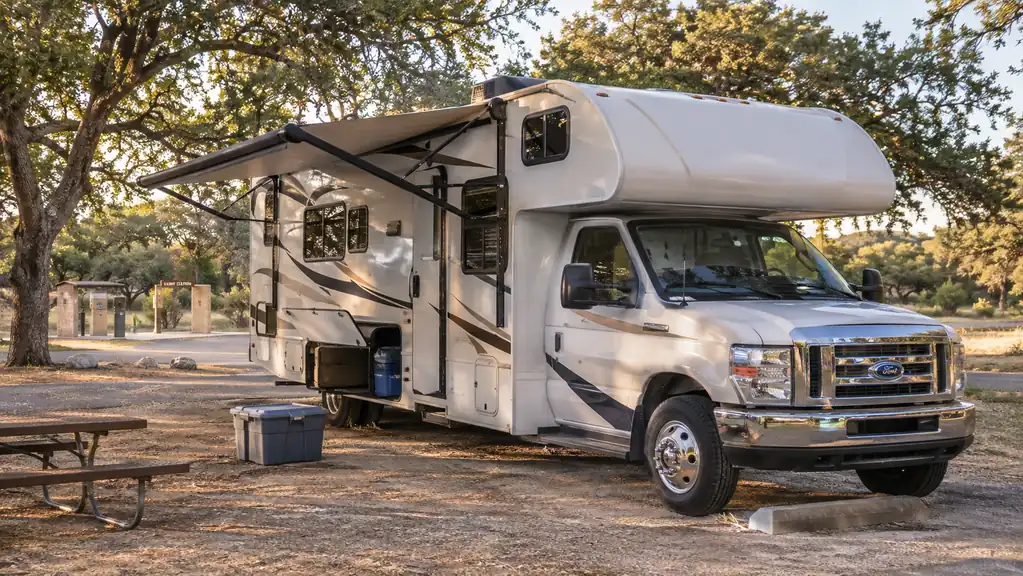
If you are standing in the RV parts aisle asking whether you need a sewer hose or a portable tote tank, the short answer is that you need the hose first. A tote tank is a useful tool for a certain kind of trip. The Camco RhinoFLEX 15 Ft Complete RV Sewer Hose Kit is the base piece that makes a full hookup site or a dump station stop work at all. Dean and I bought our Camco kit three years ago, after our second trip in the used 2019 Class C. We have never owned a tote tank, and on our kind of travel we have not missed one.
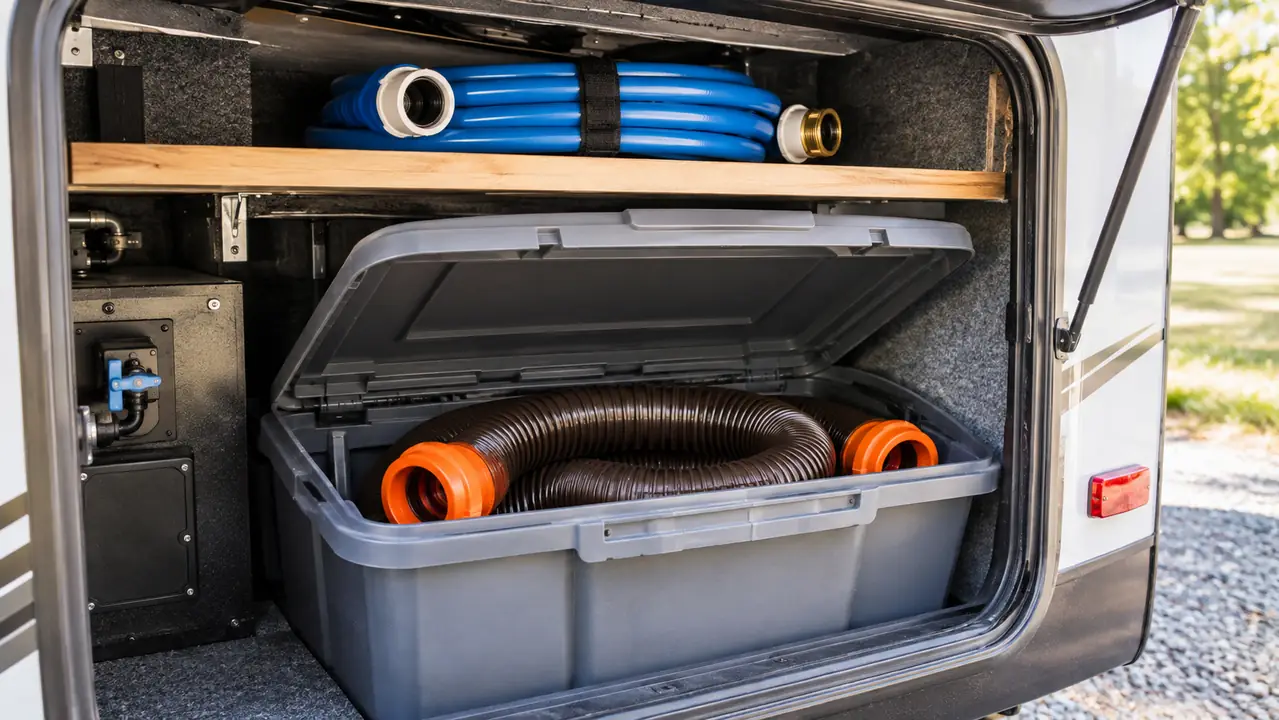
Here is our pattern. We take about six trips a year, mostly four to ten nights at state parks and private RV parks in Texas, Oklahoma, Arkansas and New Mexico. We look for full hookup sites when we can get them. When we cannot, we use the dump station on the way out. On the last morning of a trip I rinse the hose at the spigot, cap both ends, coil it, and set it in the lidded plastic bin that lives in the outside storage bay. The bin sits on the opposite side of the bay from the drinking-water hose, and it stays there. Biscuit, our seven-year-old beagle mix, rides along and does not care about any of this. A tote tank would solve a problem we do not usually have, and it would take up bay space we use for the folding chairs and the dog pen panels.
| Camco RhinoFLEX 15 Ft Kit | Portable RV Tote Tank | |
|---|---|---|
| Core job | Connects the RV outlet to a dump station and drains the holding tank by gravity | Holds waste in a separate tank until you wheel it to a dump station |
| Needed at a full hookup site | Yes. This is the hose that makes the hookup work | No. A tote tank is for sites without a sewer connection |
| Needed at a dump station | Yes. The kit includes the hose, fittings and clear elbow | Only if you are using it to carry waste from a no-sewer site |
| Setup steps | Attach the bayonet fitting, connect the clear elbow, put the other end in the dump pipe | Set the tank under the outlet, connect a short hose, fill the tank, then wheel it to the dump station |
| Handling waste | Gravity drain. No tank to lift or wheel | You handle and wheel a filled tank to the dump point |
| Storage in a 25 foot Class C | One coiled hose in a lidded bin. Kit weighs 3 pounds | A rigid tank and wheels take up bay space even when empty |
| Staying put without sewer | Limited. You need to move the RV to dump | The main reason to own one. You can stay longer and dump in batches |
| Long state park stays | Workable if you can move to a dump station | Better if the site is fixed and the dump station is a walk or short drive |
| Connection fit | Pre-attached swivel bayonet fittings and a clear elbow with a 4-in-1 adapter that accommodates 3 inch slips | Depends on the tank inlet and the short hose you add. Extra fittings may be needed |
| Cleaning routine | Rinse the hose, cap it, store it away from the water hose | Rinse the tank, wheels and hose. More surfaces to clean |
| Warranty coverage | Limited 1 year from Camco | Varies by brand, so read the listing before you buy |
| Best for | Full hookup sites and dump station routines | Boondocking or long no sewer stays |
| What it does not replace | A tote tank for no sewer stays | The sewer hose you still need to connect the tank |
Where the Camco RhinoFLEX Wins
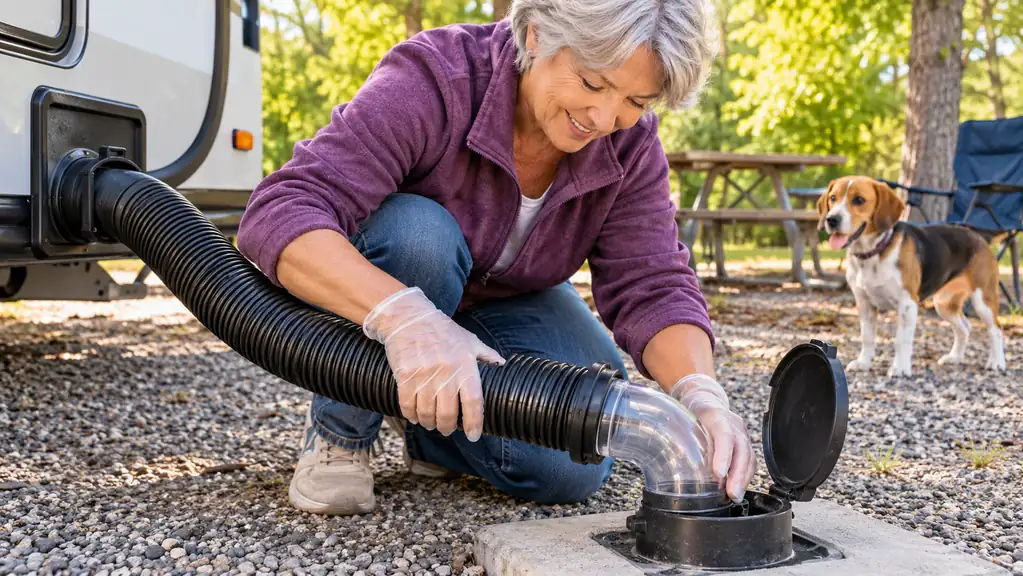
Camco RhinoFLEX wins the first question because it is the tool that every sewer stop requires. At a full hookup site, the campground gives you a sewer inlet, and you need a hose to reach it. At a dump station, you need a hose and fittings that mate with the pipe. The Camco kit comes with the 15 foot hose, pre-attached swivel bayonet fittings and a clear elbow with a 4-in-1 adapter. The adapter accommodates 3 inch slips. The hose is 3 inches in outside diameter, with a 0.023 inch wall, and the kit weighs 3 pounds. Fifteen feet is 180 inches, which sounds like a lot until you park with the outlet on the far side of the rig and the dump pipe sits behind you. I checked those numbers before we bought, because I did not want to be the couple holding up the line.
The swivel bayonet matters more than it sounds. The fitting turns on the hose end instead of making you spin all 15 feet, so you can line up the lugs at an awkward angle without fighting the coil. Our old hose, the thin one that came with the motorhome, split near the fitting on our second trip while we were at a dump station. Nothing spilled on anyone. It was a drip I rinsed away at the spigot, and we threw the hose out that afternoon. What I remember is standing there with a wet hand and no spare, and that is why I read the listing for the Camco kit that night instead of waiting until the next trip.
It also wins on handling. I am 64. I can attach a hose and open a valve. I do not want to lift or wheel a tank of waste if I can let gravity do the work. With the Camco kit, the waste goes from the RV outlet, through the hose, into the dump pipe. I rinse the hose, cap it and put it back in its bin. The clear elbow lets me see when the flow slows, which is the only check I need. I also lay the hose so it runs downhill the whole way, with a gentle slope from the RV to the pipe, because a low spot in the middle holds water and makes the end of the drain crawl. The limited one-year warranty is not generous, and I would rather it were longer. But the kit has stayed flexible through Texas summers, the fittings have not leaked, and the coil still folds into the bin without a fight.
The Camco kit weighs 3 pounds, stores in a lidded bin, and has the 4-in-1 adapter I use at the dump station.
Where a Portable RV Tote Tank Wins
A portable tote tank wins when the campsite has no sewer connection and you do not want to move the RV. That is a real advantage, not a small one. At a state park where you have paid for five nights and the dump station is a short drive away, a tote tank lets you empty the holding tank in a batch and stay put. You connect a short hose from the RV outlet to the tank, fill the tank, wheel it to the dump station, and repeat as needed. For a couple who boondocks or stays in one spot for two weeks, that can be the difference between a relaxed trip and a midweek packing drill.
I watched this work at a park in New Mexico two winters ago. The couple two sites over had a rig about our size and a site with no sewer. On their fourth morning, the husband wheeled a tank down the gravel road to the dump station and was back in his chair in under half an hour. Nobody broke camp. Nobody moved the rig. I will not pretend I did not think about it. Then I looked at how much room that tank took in their bay, and I thought about our bin and the leveler bag and the pen, and I let it go. Their trip was longer than ours. That is the whole difference.
The tote tank also wins on flexibility for the camper who moves slowly. If you are at a site without sewer and you have a dog to walk and a chair to sit in, you may not want to break camp just to dump. The tank gives you another option. But it does not replace the hose. You still need a hose to connect the RV to the tank, and you still need to rinse everything afterward, including the tank, the wheels and the short hose. The tank is a second vessel to store, a second vessel to clean and one more thing to think about on the morning you leave. That is why I say it wins a specific job, not the whole contest.
Start with the hose that makes every dump station stop simpler
For full hookup sites and dump station routines, the Camco RhinoFLEX 15 Ft Kit is the piece we use on every trip. It stores in a small bin and weighs 3 pounds.
Amazon See the Camco RhinoFLEX Kit on Amazon →What I'd Tell a Friend at the Campground
I would tell her to buy the hose first and use it for a season. You learn your own routine. You learn whether you book full hookup sites or end up at state parks without sewer. You learn how much space you really have in the bay. A tote tank is easy to want in the abstract. It is harder to store and rinse in real life. The Camco kit is easy to use from the first trip. That order, hose first and tank later if needed, saves money and space.
I would also tell her not to judge the hose by the first dump station. The first time is slow because you are learning. You are checking the fittings, lining up the elbow, making sure the hose runs downhill and the far end is seated all the way into the pipe. My first attempt took me close to twenty minutes, most of it spent crouching and second-guessing myself while Dean held the flashlight. By the third trip it was a five-minute job. The clear elbow helps because you can see the flow and know when to close the valve. That clear view is worth more to me than a fancy handle or a bigger fitting set. It tells me what is happening instead of making me guess.
And I would tell her that a tote tank is not a bad product. It is just a product for a different trip. If she stays two weeks at a site without sewer, she will want one. If she moves every three days and uses full hookups, she will not. The Camco hose is the one item she will use on every trip, even the trips where she also uses a tote tank. That is why it comes first.
The Question I'd Ask Before Buying Either
Before I bought a tote tank, I would ask one question. Where will I put it? Our 25 foot Class C has one outside storage bay. The Camco hose takes up a corner of a lidded bin. Around that bin we keep the bag with the levelers, two folding chairs and the eight panels of the dog pen. A tote tank is a rigid object with wheels and a handle. It does not fold into a corner, and it does not stack. If your rig has a large bay and you take long no-sewer trips, that space may be easy to give up. If your bay is already full, adding a tank means leaving something else at home.
The second question is who will handle it. Dean and I share the setup, but neither of us wants to carry a full tank any farther than we have to. A tote tank is made to be wheeled, not carried, and that helps. Still, it is a tank of waste, and the walk from a site to a dump station is longer at some parks than at others. At one park in the Hill Country the dump station sat at the far end of the loop, past the bathhouse. I walked it with Biscuit one evening and counted the distance in my head. If you are not comfortable with that job, the simpler answer is to choose campsites with full hookups or plan to use the dump station when you leave. That is what we do. It is not a compromise for us. It is the routine that keeps the trip easy.
Who Should Buy Which
Buy the Camco RhinoFLEX first if you are like us. You stay at full hookup sites or use dump stations. You want one hose, one bin and a setup you can do in a few minutes. You do not want to give up storage space. You want the clear elbow and the 4-in-1 adapter so you can see the flow and fit the common dump station pipes. You want a hose that weighs 3 pounds and coils small enough to live in a bin beside the levelers. The Camco kit is the base tool. It is not exciting. It is the thing I am glad to have when the line at the dump station is short and I want to keep it that way.
Consider a portable tote tank only if you have a specific need. You stay at sites without sewer for more than a few days. You do not want to move the RV to dump. You have a place to store a rigid tank. You are willing to rinse it and wheel it, and you have thought about the walk. You also understand that you still need a sewer hose to connect the RV to the tank, which means buying the Camco kit anyway, either before the tank or alongside it. For a couple in a 25 foot Class C who takes six trips a year on 30 amp hookups, the Camco hose is the first purchase. The tote tank is the second purchase, and only if the trip pattern calls for it.
The simple answer for most couples: get the hose right first
The Camco RhinoFLEX 15 Ft Kit has the fittings, the clear elbow and the 15 ft reach for the sites we use. Start there, then add a tote tank only if your campground routine demands one.
Amazon See the Camco RhinoFLEX Kit on Amazon →