
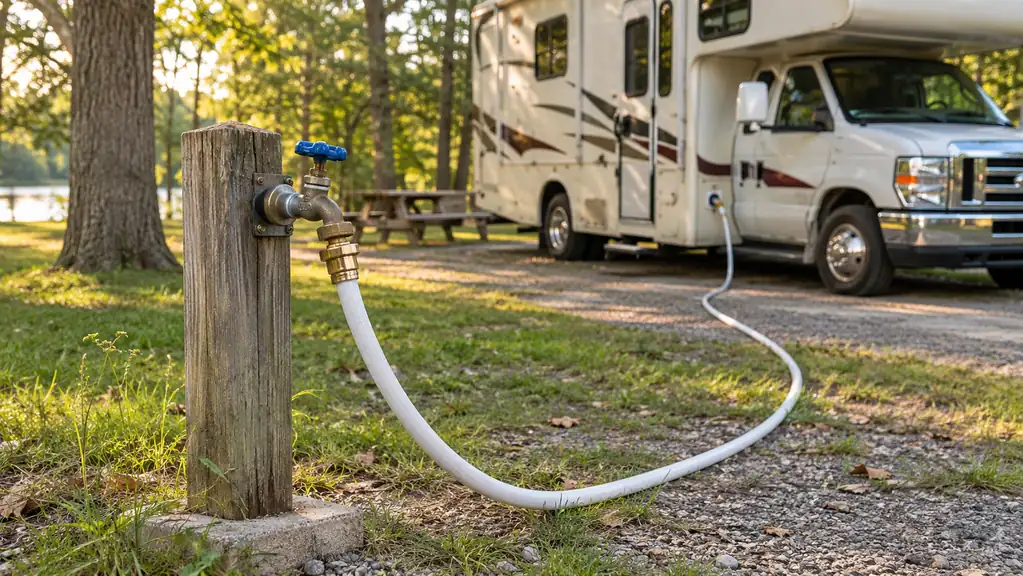
The man who sold us the motorhome did not warn us about the engine, the tires, or the roof. He warned us about the water. Campground spigots, he said, do not all behave the same, and the ones that push hard will find the weakest fitting in your rig eventually. We bought a used 2019 Class C that week. In the same order we bought a Camco Brass RV Water Pressure Regulator, three years ago this spring, and it has been screwed onto the spigot ahead of the drinking-water hose on every trip since.
I do not have a disaster story for you. Nothing burst. No fitting let go at two in the morning. What I have is three years of ordinary use, somewhere around eighteen trips, and a fairly settled opinion about what this small fitting does, what it does not do, and who should bother with one.
The Quick Verdict
A preset 40 to 50 PSI regulator with no gauge and nothing to adjust. It screws on, caps the pressure, and then stays out of your way. Three years on our rig and the only thing missing is a number to look at.
Amazon Check Today's Price →The small fitting that decides how much pressure your rig sees
Preset at 40 to 50 PSI, drinking water safe, lead-free certified, standard 3/4 inch garden hose threads. Screws on at the campground spigot in about ten seconds.
Amazon Check Today's Price on Amazon →How I've Used It
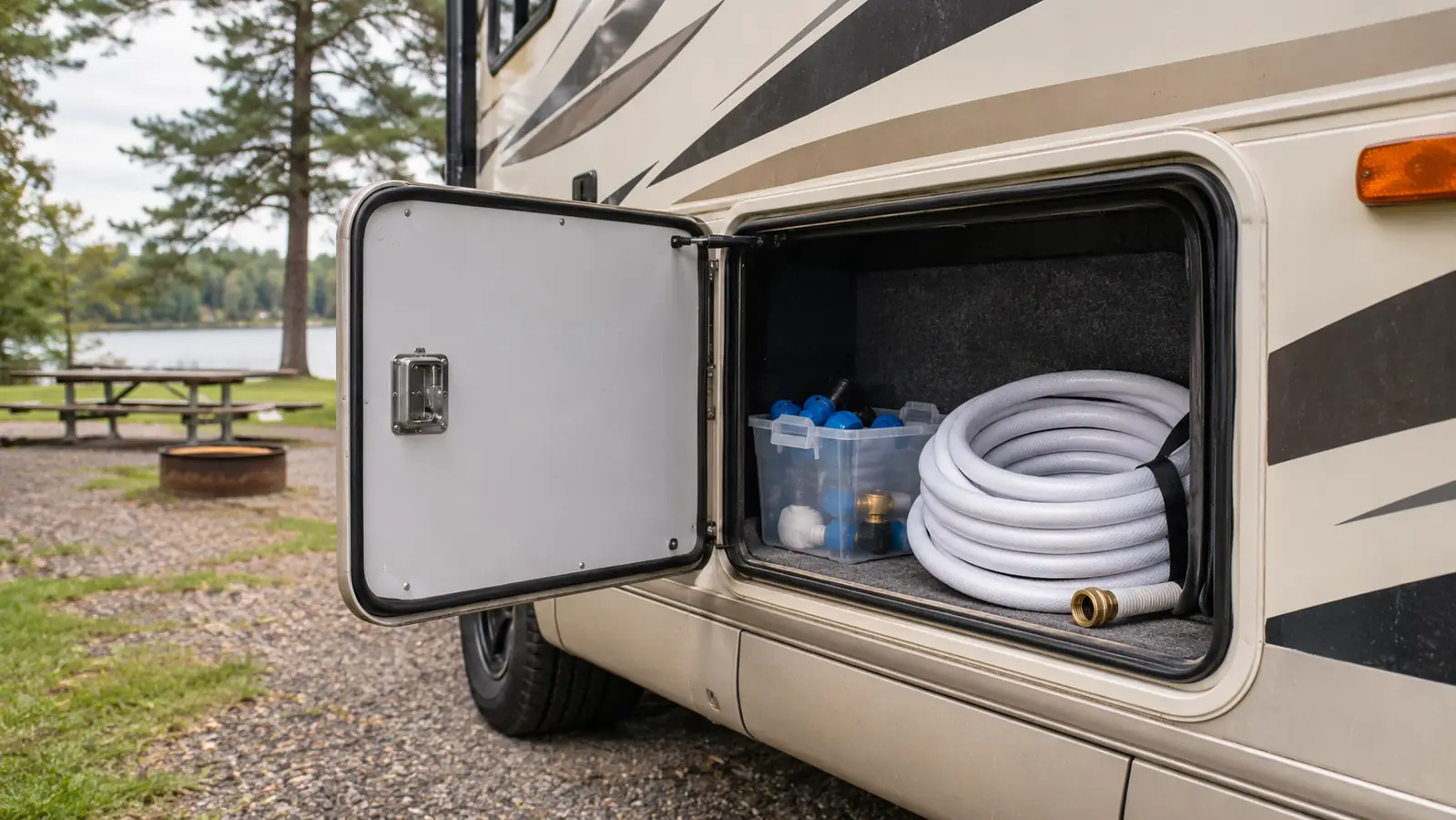
Our routine has not changed in three years. Dean pulls into the site, we walk the pad, and while he handles the leveling blocks I open the water bay. The regulator goes on the campground spigot first, hand tight, then the white drinking-water hose threads onto the regulator, then the whole thing runs to the city water inlet on the side of the motorhome. The order matters and it is the only part of setup I am fussy about. Regulator at the source, hose after it. That way the pressure is already knocked down before it reaches our hose or our plumbing.
Three years of that is maybe eighteen or nineteen trips, mostly four to ten nights at state parks and private RV parks across Texas, Oklahoma, Arkansas and New Mexico, mostly on 30-amp hookups. I have never once adjusted it, because there is nothing to adjust. I have never once had to think about it after the first thirty seconds of setup. The only care it has received is a shake to get the water out before it goes back in the bin and, once a season, a wipe of the threads with a rag so grit does not chew them up.
Let me give you one specific setup, because specifics are what I went looking for when I was reading reviews three years ago and could not find them. Last October we pulled into a Texas state park about forty minutes from our house, the one with the tall pines, and the site had a spigot set into a concrete pad with a metal riser pipe. Dean had the leveling blocks out and I had the water bin open on the picnic table. I set the regulator on the spigot, hand tight, threaded the white hose onto it, and walked the other end to the inlet. From opening the bin to water running in the kitchen sink was under two minutes, and most of that was me hunting for the little blue cap I keep losing. The part of that story worth noticing is that the regulator was not the interesting part. That is the entire point of it.
One thing I want to be clear about, because I think it sets the right expectation. We bought this because a stranger told us to, not because we understood water pressure. Three years later I understand it a little better and I would still buy the same one, but I would tell you what it is and is not before you spend anything. That is the rest of this review.

What the Little Fitting Actually Does
The listing numbers are the honest place to start. Camco rates this regulator at a maximum operating pressure of 50 PSI, with the working setting preset between 40 and 50 PSI. Preset is the important word. There is no dial, no screw to turn, no gauge on top. You screw it on and the pressure downstream is whatever the regulator decides, which is somewhere in that range. Camco describes the design as automatic pipe burst protection, and that is exactly the job. It stands between a spigot that is pushing harder than your rig was built to take and plumbing you would rather not test.
The connections are 3/4 inch garden hose thread, female iron pipe in and female iron pipe out. In plain language that means it threads onto a standard campground spigot, and a standard drinking-water hose threads onto it. That is the whole interface. It weighs 1.8 ounces and measures roughly an inch in each direction, which is why it lives in the water bin with the hose and the y-splitter and has never been left on a picnic table. The body is brass, and it is rated drinking water safe.
I got the order wrong on our very first trip out, and I want to tell you about it because I think it is a mistake a lot of people make quietly. We were at a park in east Texas, the site was muddy, and rather than kneel down at the spigot I screwed the regulator onto the motorhome end where I could reach it standing up. Water came out. The sink worked. It seemed fine. What I had actually done was leave the whole drinking-water hose and everything upstream of the regulator seeing the full campground pressure, which is the exact thing I had bought the fitting to prevent. Dean pointed it out mildly, the way he does, and I have put it at the spigot ever since. If you take one practical thing from this review, take that one.
The drinking water part deserves its own sentence. This sits on the line you fill your tank from and drink from and brush your teeth with. Anything on that line should be lead-free and certified for potable water, and this one is, to NSF/ANSI 372 and CSA. I did not know to look for that three years ago. I know now. If you are comparing this against a random brass fitting from a hardware bin, that certification is the difference between a plumbing part and a drinking water part.
Three Years of Real Spigots
Here is what three years actually looked like. Texas state parks, where a spigot is often shared between two sites and the pressure is nothing to write home about. A private park in Arkansas where the water came out hard enough that the hose jumped when Dean first opened the valve. A small park in New Mexico where the spigot was so weak I could have filled the tank by mouth. In every one of those cases the regulator did the same thing, which is to say it capped the top end and then got out of the way.
Oklahoma taught me the arrangement I would pass along to anybody. It was a small park with gravel pads and the spigot at the back of the site, on a post, with a two-way splitter already screwed on that belonged to the park. I took their splitter off, put our regulator on the spigot, then put the splitter back on the regulator. That gives you one branch to the rig and one branch for the outdoor faucet or a rinse bucket without unscrewing anything. The regulator handled both at once, which surprised me a little. The tank filled slowly that week, but that was the park's pressure and not the fitting, and without a gauge I could not have told you which.
Nothing in our rig has ever been damaged by water pressure. No fitting has failed, no pipe has burst, no hose has swollen and let go. I cannot prove the regulator is the reason and I would not try. What I can tell you is that we have hooked up at somewhere around thirty different spigots in four states, and the plumbing in a 2019 motorhome still behaves like the plumbing in a 2019 motorhome. That is the outcome I wanted.
The threads have held up well. That is the failure point on cheap fittings, in my experience with garden hoses anyway, and this one still threads on smoothly and comes off without a wrench. I wipe the threads once a season and that is the entire care regimen. If it ever started weeping at the thread I would wrap it with plumber's tape in about ten seconds, and I have not needed to.
What It Does Not Do
Now the honest part. This regulator has no gauge. You do not know what the pressure is. You know it is under 50 PSI and probably between 40 and 50, and that is all you know. If you are the kind of person who wants to see a needle, you want a different product, and Camco makes one with a gauge. I have never felt the need, because our rig has never given me a reason to chase a number, but I understand the appeal and I am not going to pretend the missing gauge is a feature.
Second, preset cuts both ways. At that weak spigot in New Mexico, the regulator was not the bottleneck, the campground was, and there is nothing this fitting can do about that. It only caps the top. It does not boost anything. If you are at a park with genuinely low pressure, your shower will be a trickle with or without a regulator, and a gauge would at least tell you why.
Third, it does not tell you when something upstream is wrong. A regulator caps pressure, full stop. It does not care whether the water is clean, whether the pedestal beside it was wired properly, or whether the park has touched that spigot since the last camper used it. Those are different jobs for different devices, and I would rather say so plainly than have you buy this expecting it to be the whole answer at the water post. I still walk over and look at the spigot before I hook anything up, out of habit, and I would keep doing that with any fitting on the market.
Fourth, a 50 PSI maximum means this is not the right part for every rig on the road. Some motorhomes are plumbed for higher and their owners run a regulator set higher. Ours is a 25 foot Class C from 2019 and 40 to 50 PSI is exactly what it wants. If your manual says something different, follow your manual instead of a review from a stranger in Texas.
Regulator or Filter, or Both
People ask me whether they should get this or a whole-RV water filter system. They are not the same tool and they do not compete. The regulator limits pressure. A filter system cleans the water. Campgrounds hand you high pressure and water that tastes like the pipe it came out of, sometimes both at once, so plenty of rigs run the two in line with the regulator first. We have never owned a filter system. We looked at listings, and we talked to a neighbor at an RV park in Arkansas who runs one, and we decided the water we get has been fine for us. That is a preference, not a recommendation. If you have ever filled your tank at a park where the water smelled like a garden hose left in the sun, a filter is the tool for that, and this fitting will not help with it at all.
What I Liked
- Preset at 40 to 50 PSI, so there is nothing to set and nothing to get wrong at the spigot
- Certified lead-free to NSF/ANSI 372 and CSA, which matters on a drinking-water line
- Standard 3/4 inch garden hose threads on both ends, so it fits normal spigots and normal hoses
- 1.8 ounces and about an inch across, so it rides in the water bin and does not get left behind
- Three years of use on our rig with no leak at the threads and no water damage inside
Where It Falls Short
- No gauge, so you never actually see the pressure
- Preset means you cannot dial it up at a weak spigot
- The 50 PSI maximum is not right for every rig, so check your owner's manual
- Small enough to forget on a spigot when you are packing up in the rain
Three years, four states, and somewhere around thirty spigots. The only thing I have ever done to this regulator is screw it on, take it off, and wipe the threads once a season.
Who This Is For
This is for the RV owner who wants the water question handled and does not want to think about it again. If you have a rig with plumbing you would rather not test against a strange campground spigot, and you are content to trust a preset instead of a number, this is the simplest version of that protection you can buy. It suits travel trailers, fifth wheels and Class C motorhomes alike, anyone on a standard hose connection. It also suits the person who is new to this, the way we were three years ago, standing in a driveway being told by a stranger that campground water is not to be trusted. And it suits the camper who has a bin of hoses and splitters and wants one small fitting in it that never needs a decision made about it.
Who Should Skip It
Skip it if you want to see the number. A gauge model exists for a reason, and if you are the type to check a dial before you open the valve, spend the extra and get one. Skip it if your owner's manual specifies something other than 40 to 50 PSI, because your manual beats my experience every time. Skip it if you are fighting low pressure rather than high, since this cannot add pressure and a gauge would at least tell you what you are dealing with. And skip it if you want one device that handles pressure and filtration together, because this is not that device.
One fitting, screwed on ahead of the hose, and the water question is handled
Preset 40 to 50 PSI. Drinking water safe, lead-free certified, brass body, standard 3/4 inch garden hose threads. Ours has been on the spigot for three years and roughly eighteen trips.
Amazon Check Today's Price on Amazon →