
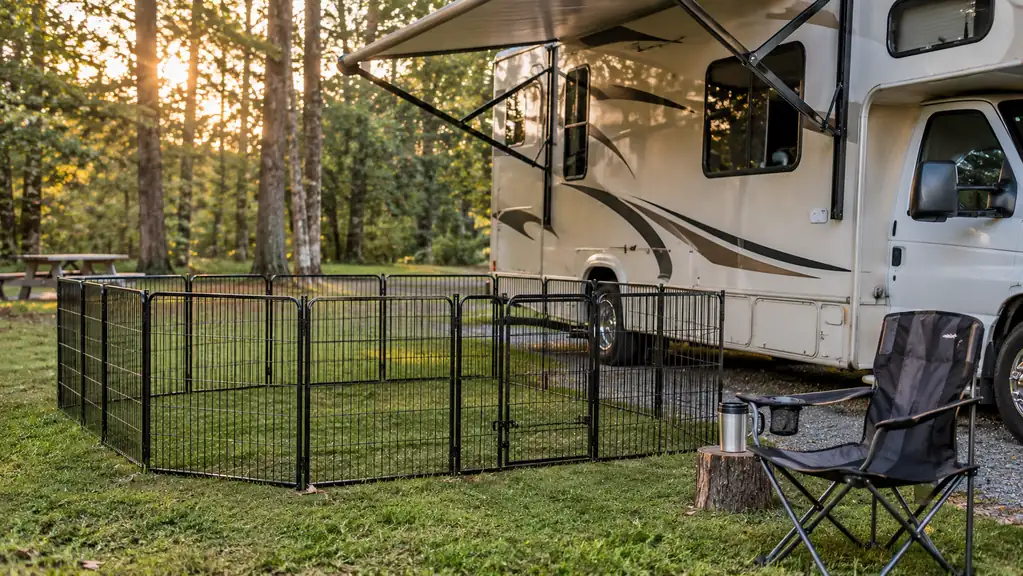
Two years ago I was on my hands and knees behind a picnic table at a state park in East Texas, untangling a tie-out cable from the table legs while Biscuit sat and watched me like I was the one with the problem. She is a 7-year-old beagle mix, about 22 pounds. She is not a jumper and not a digger. What she is, is a serious investigator of smells, and a cable turns every good smell into a knot. That was the week I ordered the FXW Rollick, and it is the last time I crawled under a picnic table for that reason.
It has been on every trip since. Call it a dozen outings in two years, four to ten nights at a stretch, at state parks and private RV parks in Texas, Oklahoma, Arkansas and New Mexico. We tow nothing, so anything we bring has to earn its space in the storage bay. This is what two years of regular use has taught us, including the parts that irritate me.
The Quick Verdict
A metal eight-panel pen that folds into a 23.8-pound bundle, goes up in about three minutes, and gives a calm small dog a patch of grass beside the RV. It will not hold a jumper, and it is not shade.
Amazon Check Today's Price →The pen that ended our tie-out years
It rides in the storage bay with the camp chairs and comes out in about three minutes. Two years in, the panels still square up and the door still latches.
Amazon Check Today's Price on Amazon →How I've Used It
The pen goes up beside the RV door, on grass if the site has grass and on the outdoor mat if it does not. It goes up when we settle in for the evening or when we plan to sit outside with coffee, and it comes down when we go in for the night or leave the site for the day. Biscuit is in it only while one of us is outside with her. That has been the rule since day one, and after two years I would not bend it. A pen is a place to be, not a babysitter.
Most sites we get are wide enough for a square, so that is the usual shape. On a narrow pull-through we have set the eight panels as a long, shallow run along the side of the motorhome, which keeps her out of the traffic lane and out of the neighbor's slide-out. The panel count is what gives you that choice. A fixed square box would have been useless on two or three of the sites we have had.
I am 64 and I do this myself. Dean handles the water and the electric; the pen is mine. It takes me about the same time as unfolding two camp chairs, and I have never once needed him to help me get it square. That matters more to me now than it would have at 40.
What the Numbers Actually Mean at a Campsite
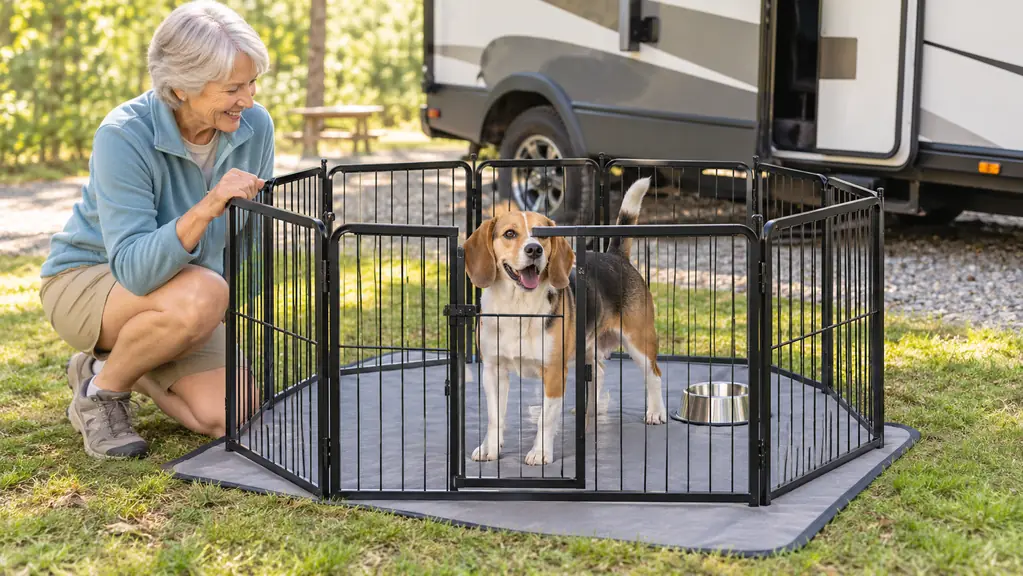
The pen is 24 inches tall. Standing next to it, that comes up to roughly my knee and well over the shoulder of a 22-pound beagle mix. For a calm dog of that size it is generous. For a 50-pound dog with springs in its legs, 24 inches is a hop and a scramble, and I would not pretend otherwise. The listing puts the dog breed size at small, and based on two years with a small dog, that reads as honest labeling rather than marketing caution.
The whole thing weighs 23.8 pounds and packs down to about 23.62 by 5.51 by 23.62 inches. In plain terms, it is a stack of metal panels roughly two feet across and a few inches thick, and it fits in the bay beside the camp chairs with room left over. It is not a one-finger carry. It is a two-hands, bend-your-knees carry, and on a site where the parking pad is a long walk from the picnic table you will feel all 23.8 pounds.
Eight panels, metal, square when set as a square, and the listing gives the assembled footprint as 46.5 inches by 46.5 inches. That is enough floor for a bed, a water bowl and a dog to turn around without stepping on her own feet. The door has a latch and, per the listing, an automatic gravity-actioned locking mechanism that lets it open and close smoothly. FXW says assembly takes no more than five minutes, and my own experience is closer to three once you know the panels.
Setup and Takedown at a Campsite
The first time took me longer because I was being careful. Now it goes like this: pull the bundle out of the bay, set it on the ground, unfold the panels and walk them around until they square up, then swing the door panel into place at the front so I can reach her without climbing over. There is no tool involved and nothing to tighten. The panels are rigid metal, so they line up or they do not, and there is no halfway setting to fuss with.
Takedown is the same in reverse and takes about as long. If the grass was wet I wipe the panels down with a rag before they go back in the bay, because wet metal sitting in a closed compartment for a week is how you get rust spots. That is not a knock on the pen; it is what metal does. It has taken two years of this and the panels still square up and the door still latches, which is the test I actually care about.
On gravel or packed dirt I set it on the outdoor mat instead of directly on the ground. The panels sit better on something flat and the dog is not standing in grit all afternoon. After a night of rain the mat also keeps the bottom rail from working its way down into soft ground. None of that is complicated and none of it is specific to this brand. It is just how you set up a panel pen so it behaves.
How Biscuit Does in It
She settles. That is the short version. She can see us, she can hear the campground, and she is not tied to anything, so she can pace the perimeter and sniff the corners and then lie down in whatever shade we have arranged over one end. The first trip she tested the door once and found it latched. She has not tested it since. Two years and she has never jumped it, pushed a panel out of line, or dug at the grass.
What the pen does not do is provide shade, and metal in full Texas sun is hot to the touch by early afternoon. We move it to the shaded side of the motorhome, or we drape a towel over one corner and leave the rest open so she can still see out. That is not a flaw in the product. It is a flaw in expecting a fence to be a tree.
It is also not a crate. We do not leave her in it while we drive into town for groceries, and we do not leave it out overnight. Its job is the hour or two when we are sitting outside and she wants to be outside with us. For that job, in two years, it has not once given me a reason to worry.
Inside the Motorhome on a Rainy Day
The listing calls it an indoor pen too, and we have used it that way twice, both times on a rainy afternoon in New Mexico when the dog had been cooped up and we had run out of ways to entertain her. Set as a smaller square on the vinyl floor of the Class C, it gives her a place to be that is not underfoot while I cook.
It is not a perfect indoor solution for us. The panels are rigid and the rig is 25 feet, so a square big enough to matter eats most of the floor between the dinette and the door. We use it inside sparingly. Outdoors is where it earns its keep.
What Two Years of Trips Did to It
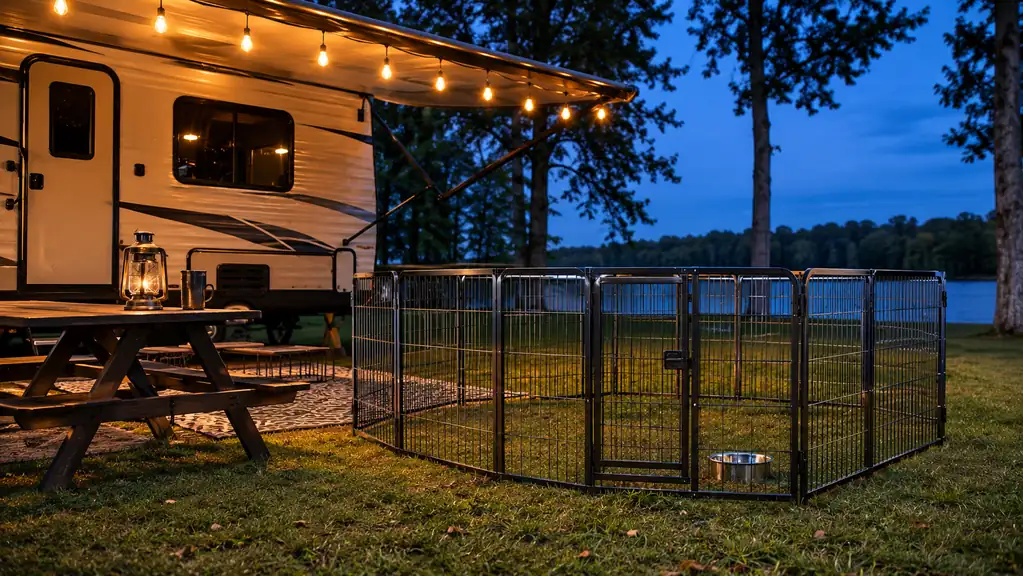
Two years is long enough for gear to show you what it is. The panels still square up to a true square without my having to fight the last one, which is the thing I expected to go first. The door still latches with the gravity lock and still swings without sticking. There are no rust spots, but I wipe it down after wet grass, and I would not promise the same for someone who folds it away damp and leaves it for a month.
The only wear I can point to is cosmetic: scuffs where the panels meet, and a couple of small dings on one bottom rail from being set down on gravel more times than I can count. Nothing has bent out of shape and nothing has come apart. For a piece of gear that lives in an unheated storage bay through a Texas summer, that is better than I expected when I ordered it.
The Annoyances, Honestly
The weight is the main one. 23.8 pounds does not sound like much until you are carrying it plus a water bowl across a gravel pad in a crosswind. If a site is a long way from the parking pad, I make two trips. That is my choice, not a defect, but if you are looking for something you can sling over one shoulder and forget about, this is not that piece of gear.
The panels talk. Metal on metal, when you are unfolding them, makes a racket that carries across a quiet campground at 7 a.m. I have learned to unfold them one at a time and set each one down instead of letting the stack clatter. Small thing, but the neighbors at a state park notice small things.
And the grass under it will yellow after three or four days in one spot. We shift the pen a few feet every couple of days, which takes thirty seconds and keeps the site looking like we were never there. Which is worth saying plainly: on a site with a leave-no-trace rule, a panel pen you can pick up and move is easier to comply with than anything anchored into the ground.
What I Liked
- Sets up in about the time it takes to unfold two camp chairs, no tools
- Holds a calm small dog without a tie-out cable to tangle around table legs
- Eight panels let you reshape it for narrow pull-through sites
- Folds to a 23.62 by 5.51 by 23.62 bundle that fits beside the camp chairs
- Metal panels and a latch that still work after two years of regular trips
- Gravity-actioned door lock that a dog cannot nose open
Where It Falls Short
- 23.8 pounds is a real carry from the storage bay to the site
- 24 inches of height will not hold a jumper or a larger dog
- No shade, and bare metal gets hot in afternoon sun
- Wants a mat under it on gravel or wet ground
- Not something you leave out overnight or use as a crate
Two years, about a dozen trips, and the pen has never failed to hold a calm 22-pound dog who would rather sniff than jump. I cannot say the same for the tie-out cable.
Compared to the Tie-Out Cable We Retired
The cable cost less, weighed less, and took ten seconds to set up. It also wrapped around the picnic table legs, wrapped around the camp chair, and once wrapped around my ankle while I was carrying coffee. Biscuit spent the whole time at the end of it, pulling in whatever direction the smell was coming from, and I spent the whole time unwinding her.
The pen is the opposite trade. Heavier, minutes instead of seconds, and it gives her a boundary she can move around inside. She sniffs the whole perimeter, picks a corner, and lies down. If I had to choose between the two again, knowing what I know now, I would take the weight and the setup time.
Who This Is For
This is for the camper with a small or medium dog that is calm, that is not a fence tester, and that mostly wants to be near you while you sit outside. It suits a couple in a Class C or a travel trailer who wants a patch of grass to belong to the dog for an hour, and who does not mind spending three or four minutes on setup. If your dog is 25 pounds or under, calm, and supervised, the FXW Rollick does what the listing says it does.
Who Should Skip It
Skip it if your dog jumps. Twenty-four inches is generous for a beagle mix and nothing at all for an athletic 45-pound dog, and no pen at this height changes that. Skip it if you want to leave the dog and walk away; that is a crate job, not a pen job. And skip it if the carry matters to you, because 23.8 pounds of metal is a real lift, and lighter options exist if lightness is the thing you care about most.
Two years in, it still goes in the bay with the camp chairs
If you have a calm small dog and a campsite routine, this is the piece of gear that makes sitting outside pleasant again instead of a job of unwinding cable.
Amazon Check Today's Price on Amazon →