
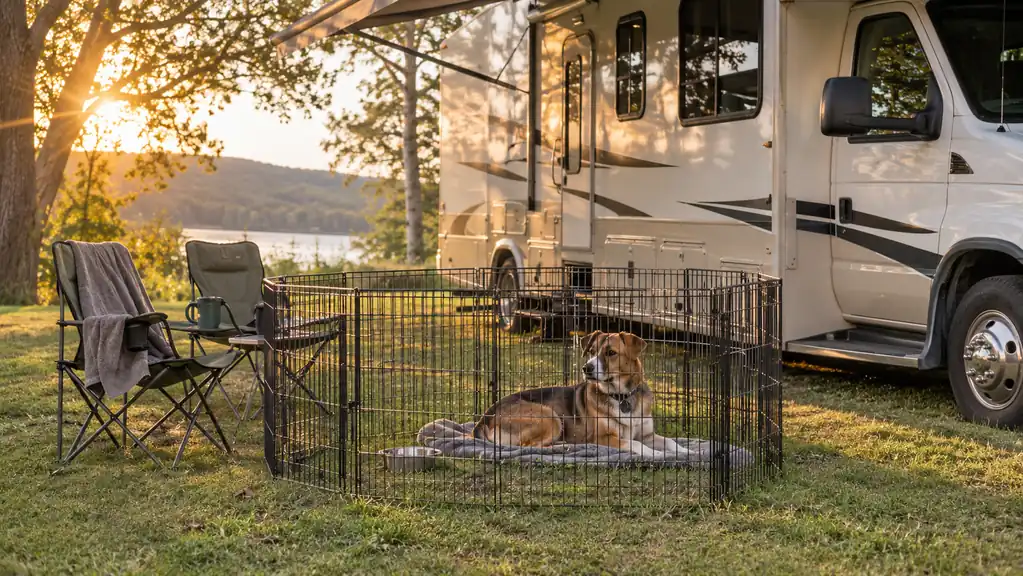
Two years ago I sat at the dinette table in our Class C with a wireless dog fence listing open on my laptop, trying to talk myself into it. No panels to haul. No hardware to set out on ground that turns to brick in an August drought. The dog wears a collar, the boundary lives in the air, and everybody is happy. Then I read the part about training the dog to that boundary over several weeks, and the part where the collar has to be charged before every trip, and I closed the laptop. We bought the FXW Rollick playpen instead. Biscuit, our seven year old beagle mix, has spent every camping trip since then inside it, and I have never once wished we had gone the other way.
Here is the short answer. A wireless fence buys you room and gives up certainty. The FXW Rollick buys you certainty and gives up room. If your dog is calm, stays close, and you are sitting outside with her anyway, the pen covers everything you need. If your dog needs real space to be happy and you have the patience to train her to a boundary, the fence is the better tool. Those are two different dogs and two different campsites, and only you know which one you have.
| FXW Rollick | Wireless Dog Fence | |
|---|---|---|
| What actually stops the dog | Eight metal panels make a wall about 23.6 inches tall | A warning tone, then a correction from the collar as she nears the edge |
| Setup at a new campsite | Panels unfold and latch, no tools, nothing to charge | Transmitter plugged in, boundary set, collar charged before you left home |
| Room to move | A fixed square, about 46.5 inches on a side | Whatever radius you set, which on a big grassy site is often the whole site |
| A dog with no boundary training | Works on day one, no training at all | Needs weeks of work before it is reliable |
| Power and hookups | None needed, works at a site with no electric at all | Transmitter wants an outlet, the collar wants a charge |
| Packing and storage | 23.8 pounds of panels in the storage bay | A small transmitter and a collar on a charger |
| What it asks of you during the day | Eyes on the dog, because panels are not a crate | Runs without you watching, until a startled dog bolts through a correction |
What Each One Actually Does
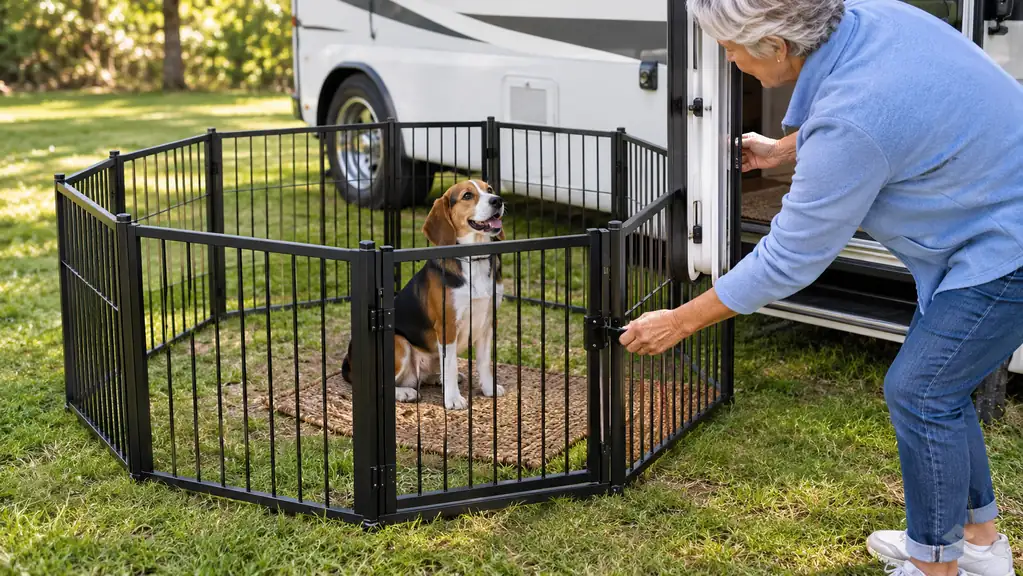
The FXW Rollick is eight metal panels that latch into an enclosure. The listing gives a square setup of about 46.5 inches on a side, 23.6 inches tall, and 23.8 pounds for the whole thing. The door has an automatic gravity actioned latch, which is a plain way of saying it drops shut behind you when you swing it. FXW says assembly takes under five minutes, and I believe them, because I have done it in a light rain in about that. There is no battery, no app, nothing to charge, nothing to plug in.
A wireless fence is the opposite kind of product. A transmitter sits inside the rig or on a post, the dog wears a collar, and you set how far she can go before the collar warns her and then corrects her. Nothing about it is physical. No wall, no gate, no panel. The dog is held by a rule she has to learn, and how well she learns it depends on her temperament, her age, and how much time you put in at home before the trip. That is not a flaw in the design. It is what the design is.
Before the pen, we clipped Biscuit to a tie out cable on a ground stake. It worked, in the sense that she stayed attached. It also wrapped around the picnic table legs twice a day, and I spent a good part of every afternoon unwinding a twenty two pound dog from a piece of hardware. When we moved to the FXW Rollick, the unwinding stopped. That is the honest reason we bought it, not any grand theory about containment.
One thing I want to be clear about, because campers ask me about this pen all the time. It is not a place to leave a dog alone for hours while you drive into town for groceries. It keeps her in a spot you can see from your chair. It does not babysit, and it is not sold as something that does.
Where the FXW Rollick Wins
It wins on certainty, and for a dog like mine that is the whole argument. Those panels are there whether or not Biscuit understands them. She cannot decide to test the boundary on a gusty afternoon, because the boundary is a wall she can see. A collar depends on the dog accepting the correction, and a dog that is frightened or excited enough can go straight through one. I watched a woman at a park in Arkansas call and call while her dog stood thirty feet outside the boundary, looking back at her like she had lost her mind. It had never happened before, she said. It only has to happen once.
It also wins on power and on the first five minutes. We have stayed at sites with 30 amp hookups all over Texas and Oklahoma, and we have stayed at a couple where we used nothing at all. The pen does not care either way. It goes up in the same five minutes whether we have electric or not, and nobody has to remember to charge anything before we pull out of Tyler. On a two night trip, that counts for more than people who camp once a summer would guess. Less to remember is worth a lot on the road.
Where the Wireless Fence Wins
It wins on room, and it wins big. Our setup gives Biscuit a square roughly four feet on each side. That is fine for a calm beagle mix who mostly wants to lie in the shade and watch me carry things. It is not fine for a young Labrador or a herding dog that needs to run. A fence on a large grassy site at a private park gives that dog real exercise while you are connecting the water hose. If your dog paces in a small pen, no amount of latching will fix it. That is not a knock on the pen. It is a mismatch between the dog and the tool.
It also wins on packing. Twenty three point eight pounds of panels is not a small thing in a 25 foot motorhome with a storage bay that already holds a sewer hose bin, a leveler bag, and the water gear. Ours lives between the hose and the levelers, and I feel it every time I slide it in. A transmitter and a collar would disappear into a drawer and I would forget where I put them. If space is tight in your rig, that is a genuine point in the fence's favor, and I would rather say so than pretend otherwise.
No boundary training, no collar to charge, and it goes up in five minutes
That was the whole argument for us. Biscuit was inside the FXW Rollick on the first afternoon we owned it, with no training at all, and it is still the first thing Dean pulls out of the storage bay two years later.
Amazon Check Today's Price on Amazon →
The Training Question
Here is what decided it for us, and it has less to do with the products than with our dog and our calendar. A wireless fence is only as good as the training behind it. You lay out the boundary at home, you walk the dog around it on a lead, you teach her what the tone means before you ever trust the correction to do the work. Done properly, that takes weeks. We travel about six times a year, mostly four to ten nights at a stretch. I did not want to spend a winter training Biscuit to a boundary I would use on a handful of summer weekends.
If you are a full timer, or you camp forty nights a year, the training pays for itself many times over. Your dog learns it once and the boundary travels with you. That is the right call for that life, and I would not try to talk a full timer out of it. For six short trips a year, the pen is the tool that works on day one with a dog who has never seen it before. I will take day one over a promise every time.
Setting It Up at a New Site
What actually happens, in order. Dean pulls the panels out of the bay while I walk the site and pick a spot. Grass is best. The outdoor mat in front of the door works too, as long as the site is fairly level. We unfold the panels, latch them into a square on the flattest patch we can find, and that is the job. Ten minutes if we are being slow and talking to the neighbors. Then Biscuit goes in, and the rest of the setup, the water, the power, the levelers, happens without a dog underfoot. That is the actual gift of the thing. Not containment. Two free hands.
Two complaints, and they are small ones. On a concrete pad the panels have nothing to grip, so the whole square can slide if a dog leans on it. On those sites we set it on the mat with the door side against the RV and it holds fine. Second, 23.8 pounds is real weight to haul out and put back, twice per trip, and my back notices on the second morning. Neither one has ever made me want a different product. Both are the kind of thing you should know before you buy.
Two years, six trips a year, and Biscuit has never pushed a panel out of place. That is the whole endorsement.
One more note about wind. An empty pen on an exposed site will move in a gust. With a dog inside it, it does not. We spent an afternoon at a park outside Amarillo with wind coming across the site hard enough to rattle the awning, and the pen stayed put because Biscuit was in it, lying down, unbothered. If you plan to leave it standing overnight with nobody in it, take it down. I learned that from watching a man chase a panel across a site, and I did not need to learn it twice.
Who Should Buy Which
Buy the FXW Rollick if your dog is calm, if she is not a jumper, if you will be outside with her rather than away from the site, and if your trips run a handful of nights at a time. The listing puts it at small breed size and I would not argue with that. Biscuit is about 22 pounds and the 23.6 inch height fits her with room to spare. A big dog who wants to go over the top would go over the top. It suits anyone who does not want one more battery to remember, and it suits a couple like us, six trips a year, state parks and private parks, 30 amp hookups, one calm dog who mostly wants to be near Dean.
Buy the wireless fence if your dog needs room, if you camp enough that the training is worth a winter of evenings, and if you have an outlet at the pedestal for the transmitter. It is the better product for a full timer with a young dog on a big grassy site. It is the wrong product for a dog who is frightened by a correction, or for an owner who wants containment to be a physical fact rather than a trained habit. And if your dog is a serious jumper or a bolter, neither one is the answer. A fence will not stop a dog who is determined to leave the property.
If your dog is calm and your trips are short, this is the one to buy
Eight panels, about five minutes, nothing to charge, and a door that latches itself. Two years beside our door and it still does exactly what it did the first afternoon. Today's price is on the listing.
Amazon Check Today's Price on Amazon →