
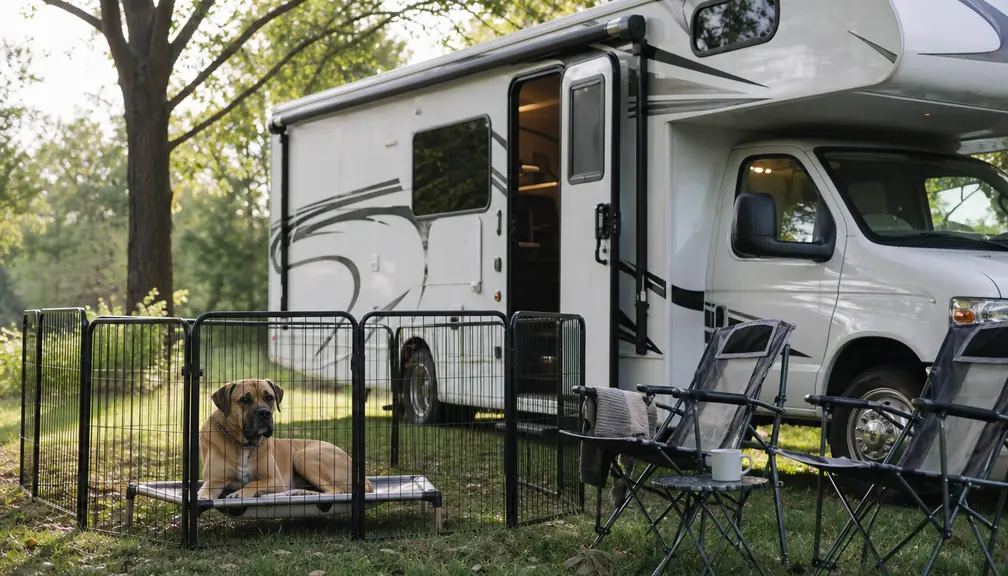
The first time we camped with Biscuit, we did what everybody does. Dean screwed a ground stake into the grass beside the motorhome, I clipped the cable to her collar, and we sat down with our coffee like people who had this handled. Ten minutes later the cable had wrapped itself around a picnic table leg, then a camp chair leg, and Biscuit was standing there looking at me like I had arranged it on purpose.
Biscuit is a 7-year-old beagle mix, about 22 pounds, calm and not a jumper. She is not a hard dog to manage. The cable was the hard part. We retired it about two years ago and bought the FXW Rollick Dog Playpen, the 24 inch, 8 panel version, and it has ridden in the outside storage bay on every trip since. What follows is the setup we actually use, in the order we use it, plus the handful of things that took us a full season to stop getting wrong.
The pen that replaced the tie-out cable in our rig
24 inches tall, 8 metal panels, and a door latch Biscuit has not worked loose in two years. It folds into a bundle about the size of a card table top and stores on end in the bay.
Amazon Check Today's Price on Amazon →Step 1: Choose the Spot Before You Unhook
The mistake we made the first three times was setting the pen up wherever the grass looked nicest, then discovering we had put it directly in the path everybody walks to the bathhouse. Now I walk the site before Dean finishes leveling. Three things matter to me: where the RV door opens, where the shade lands at four in the afternoon, and how close the neighbor's dog happens to be.
The assembled pen measures 46.5 inches by 46.5 inches, a little under four feet on a side, so it wants a patch of ground roughly the size of a small dining table. Ours goes beside the door on the awning side, on grass if the site has grass and on the outdoor mat if it does not. Gravel works, but the panels sit better on something flat, and I got tired of picking gravel out of the folded bundle every single time.
Last April, at a state park outside Nacogdoches, I finally took a tape measure to it and stopped guessing. The site pad was ten feet wide, and the awning side gave me four feet of grass before the neighbor's picnic table started. Four feet is exactly what the pen wants, which left no margin at all. I moved it back toward the rear wheel and wound up with the door sitting at a right angle to their fire ring instead of facing it. Nobody said a word, but their dog quit pacing the edge of their site, and so did ours. Two minutes with a tape measure on the first afternoon saved us a week of small bother.
One caution about the awning. When rain comes, water runs off the awning edge in a line, and that line will land inside the pen if you let it. I set the pen far enough out that the drip line falls clear of it. Biscuit does not care for being rained on, and I do not blame her one bit.
Step 2: Assemble the Panels in the Order You Will Take Them Apart
The panels arrive folded in a stack and open into a square. Eight panels, metal, and by the manufacturer's estimate the whole thing goes together in under five minutes. That matches our experience now, though the first assembly took me closer to fifteen because I was being careful and read the directions twice.
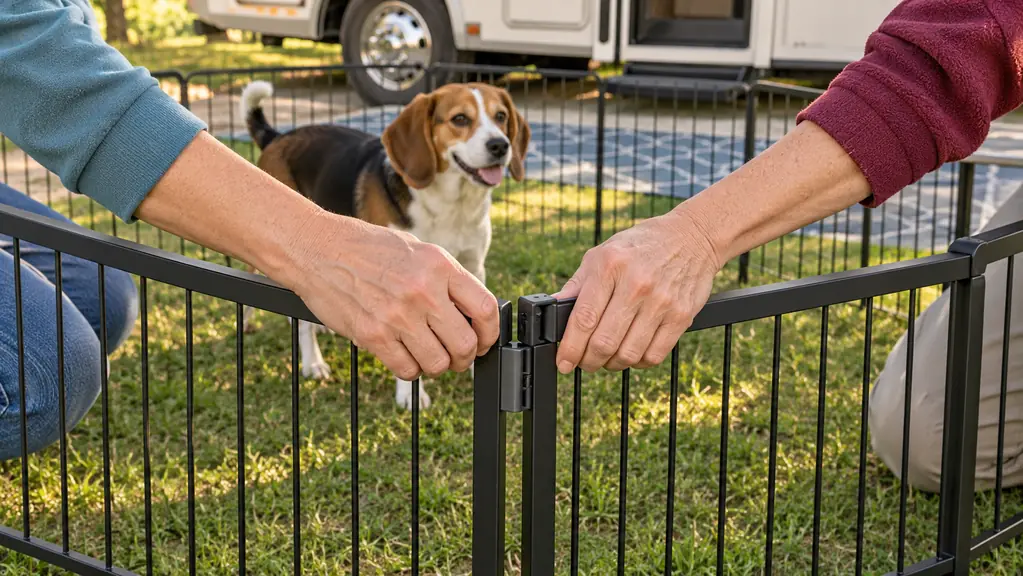
I lay all eight panels out flat first and check that the latches face the same direction. Then I stand them up and connect them one at a time, walking around the square as I go. Each joint has its own latch, so when it comes time to take it down I simply reverse the walk. Working from the outside means I never have to climb in and out over a 24 inch panel with an armful of bed and bowl.
Here is the thing I wish somebody had told me in year one: latch direction matters more than it sounds. That first season I connected panels whichever way they happened to be lying, and half the joints ended up with the release tab on the inside, where I had to reach over the top to get at it. Now I lay them all face down, then flip the whole stack at once, so every tab sits on the outside of the finished square. It is a small thing. It is also the difference between opening the pen one-handed with a leash in the other and setting the leash down in wet grass.
The door uses a gravity actioned locking mechanism. In plain terms, the latch drops into place on its own when the door swings shut, and you lift it to open. Biscuit has never worked it loose, and she has had two years of chances. I still check it with my hand every time I close it, the same way I check the car door out of habit.
Step 3: Put the Door Where You Can Reach It Without Stepping In
Our first layout had the door on the far side, which meant stepping over a panel every time I wanted to hand Biscuit her water bowl. Now the door faces the RV door, about three feet away. I can open it from the bottom step without setting my coffee down, and at my age that counts for something.
That three feet of space matters more than it sounds. It gives me somewhere to stand while she comes out, so she is not pushing past my legs, and it means the pen is not jammed flat against the side of the motorhome where I cannot get behind it to lift a panel or sweep out the grass.
We learned about the swing the hard way in Oklahoma, on a site where the pad sloped just enough that the door closed itself every time I let go of it. Not a latch problem, just gravity doing what gravity does. I turned the whole pen a quarter turn so the door faced uphill, and it stopped. Since then I check the swing before I connect the last panel, and if the door will not stay where I put it, I rotate the square. Fifteen seconds of work. Saves me walking the long way around forty times in a week.
If you have an older dog or one with sore hips, 24 inches is a low step but it is still a step. We keep a folded mat at the pen door so Biscuit has something solid under her feet going in and out. That was Dean's idea, and it is a good one.
Step 4: Make It Somewhere She Wants to Be
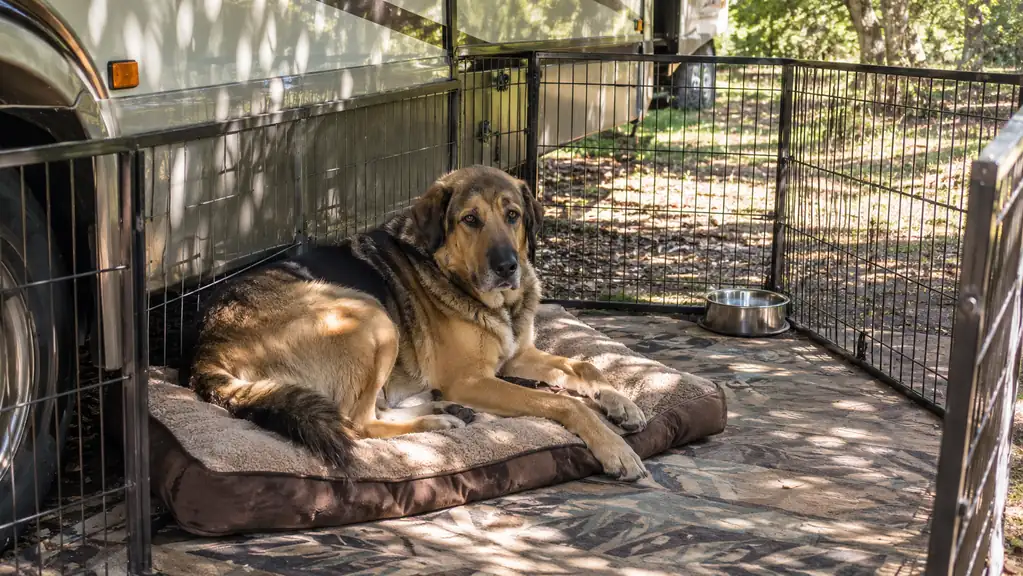
A pen is just a cage if there is nothing in it. Ours holds three things: a water bowl, a bed, and whatever chew she is working on that week. The bed goes in the shaded corner. In the morning that is the west side of the pen; by three in the afternoon it is the east side, so I move it. Ten seconds of work, and it is the difference between her lying down and her standing at the panel staring at me.
The very first trip we used the pen, I put nothing in it at all. I had this notion that she would lie down in the grass and enjoy the view like a dog in a paint commercial. She stood at the panel and stared at me for the better part of an hour. Dean finally went inside, came back out with her bed, and set it down in the shade. She was asleep inside of five minutes. That was the whole lesson. A pen with a bed, a bowl, and her own chew in it is a room. A pen with nothing in it is a fence, and she knows the difference better than I do.
Water bowl placement is the thing I got wrong longest. I used to set it by the door, which is where she walks, so it got stepped in and tipped twice a day. Now it sits in the corner farthest from the door, in shade, and I dump and refill it each morning when I do ours.
She is supervised in there. That is not a campground rule invented to annoy us, it is just sense. A pen keeps her from wandering off and keeps other dogs from wandering in on her, but it does not make decisions for either of them. One of us is outside with her, or she is inside the motorhome with us. There is no third option.
Step 5: Take It Down and Store It So Next Time Takes Five Minutes
Take down is the reverse walk: unclip the panels in order, stack them, fold the stack. The bundled pen measures about 23.6 by 5.5 by 23.6 inches and weighs around 23.8 pounds. Dean carries it. I could carry it, but he is 66 and likes to feel useful, and honestly it is an awkward shape more than it is a heavy one.
It rides in the outside storage bay standing on end against the wall, with a bungee strapped across so it does not slide when we turn. Before it goes in, I wipe the panels down with a rag if the ground was wet. Grass and mud left on metal for a month inside a closed bay is how a good thing starts to look old before its time.
One last habit for pack-down: count the panels. Eight in, eight out. We have never lost one, but I once watched a camper pull away with two panels still leaning against a picnic table, and I have counted ours every trip since.
What I Liked
- Goes up and comes down in minutes, so we use it on a two-night stop, not just a long stay
- 24 inches tall with a gravity latch that Biscuit has not worked loose in two years
- Folds into a flat bundle that stores on end in the outside bay without taking the whole shelf
- Eight panels is enough to make a square or a longer, narrower run along the side of the rig
Where It Falls Short
- 23.8 pounds is not light, and the folded bundle is an awkward shape to carry any distance
- 24 inches is not a height for a jumper. Biscuit is calm, but a dog who clears it would need something taller
- On gravel or uneven ground the panels sit slightly off unless you give them something flat underneath
- It is a pen, not a crate, so it does not replace having a person outside with the dog
Twenty-two pounds of calm beagle beat a ground stake and a cable in about ten minutes. The pen has held her for two years and has never once wrapped itself around a picnic table.
What Else Helps
A pen is one piece of a campsite setup, not the whole thing. Almost every park we stay at has a leash rule, usually six feet, and it applies whether or not your dog is inside a fence you brought yourself. I ask at the office when we check in, every time, because the rules differ from park to park and the person at the desk knows the answer in ten seconds.
Shade is the other thing. A Texas afternoon in July will run a dog off her feet no matter how good the fence is, so we favor sites with a tree or we run the awning out and put the pen under it. On the hottest trips I freeze a plastic bottle of water overnight and drop it in the pen in the morning. Biscuit ignores it for an hour and then lies against it.
And give the first setup a little patience. The first time we put the FXW pen up at a campground, Biscuit walked the inside edge twice, sniffed every panel, and then lay down by the door and sighed. Now she goes straight in when I open it, because she knows the bed and the bowl are in there. That took about three trips to build, and it was worth every one of them.
Two years of trips, one pen, no escapes
The FXW Rollick in the 24 inch, 8 panel size. If your dog is calm and under about 25 pounds, this is the one we would buy again, and we would set it up beside the door exactly the way we do now.
Amazon Check Today's Price on Amazon →