

Dean and I bought our used Class C three years ago, and I still remember the campground volunteer who looked at our power cord and said, honey, plug something into that pedestal first. I nodded as if I understood. I did not understand. What she meant was a surge protector, and what I have learned since is that the little box we bought that week, the Progressive Industries SSP-30XL, does a job I never thought about in forty years of paying electric bills. It sits between the campground and the RV. That is the whole idea.
We travel about six times a year now, mostly state parks and private RV parks in Texas, Oklahoma, Arkansas and New Mexico, almost always on 30-amp hookups. Biscuit rides along and Dean drives. After three years of plugging that protector in at every single site, I have a list of reasons it stays in the cord bag. I will give them to you the way that volunteer gave them to me: plainly.
The one thing I plug in before the RV's cord
Rated for 30 amp and 120 volts, 3,600 watts, with 825 joules of surge absorption. It lives in the cord bag and takes about ten seconds at the pedestal.
Amazon Check Today's Price on Amazon →It reads the pedestal before your RV does
The first thing you do at a new site is look at the pedestal. This one has LED indicators that tell you what the outlet is actually doing before your motorhome's cord goes anywhere near it. Open ground, reverse polarity, that family of problems. You are not guessing. You are reading a light and then deciding whether to walk to the office. That order matters, and it is why this is the first item on the list instead of the tenth.
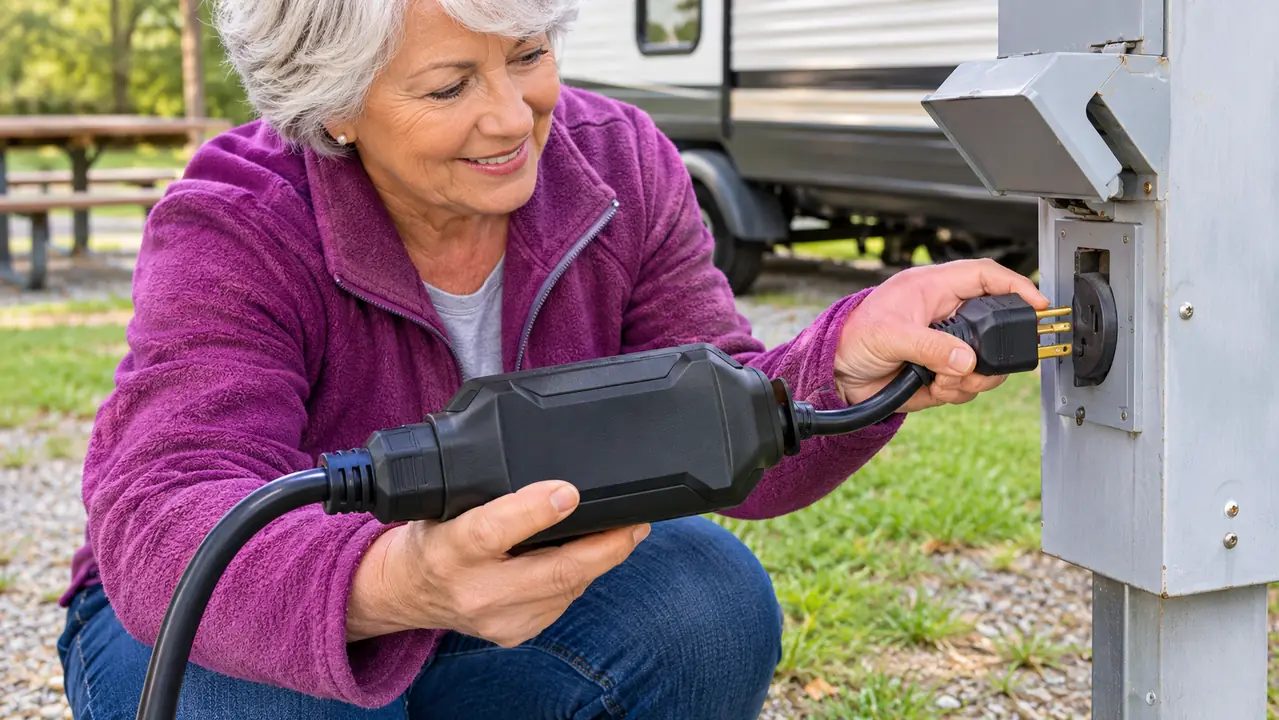
One evening in Arkansas settled the question for us
In our second year we pulled into a private park and plugged the protector in, and its indicator told us the pedestal had a wiring fault. Nothing dramatic happened. No smoke, no noise, nothing to tell at the campfire. Dean walked to the office, explained what the light said, and the woman behind the counter moved us two sites down. The new pedestal read clean. We never learned what was wrong with the first one, and we never had to. Nothing in our rig has ever been damaged, and I would like to keep it that way.
It puts 825 joules between the grid and your appliances
The listing rates this at 825 joules of surge absorption, 30 amp, 120 volts, 3,600 watts. I am not an electrician and I will not pretend that number means more to me than it does. What I do understand is the arrangement. A campground's wiring is not your house's wiring, and every appliance in your rig sits downstream of whatever happens at that box. A protector is a place for a spike to stop. That is enough for me.
It matches the 30-amp hookups you actually use
Our motorhome is a 30-amp rig and most of the sites we book are 30-amp sites, so a 30-amp protector is not a compromise, it is the correct part. If you have a 50-amp coach, buy the 50-amp version and do not try to fudge it with an adapter. Buy the one that matches your cord. If you are not sure which you have, look at the plug on the end of your shore cord before you order anything. That is what the neighbor two sites over told us, and she was right.
Two pounds and fourteen inches, so it lives in the cord bag
The listing gives it as 2 pounds, 14 inches long by 5.25 inches wide. In practice: it goes in the bag with the shore cord, it comes out at every hookup, and it never feels like a piece of equipment I have to make a decision about. Portable is the word the manufacturer uses, and for once the word is accurate. Dean hangs the bag on the hook by the door and that is the end of the storage conversation.
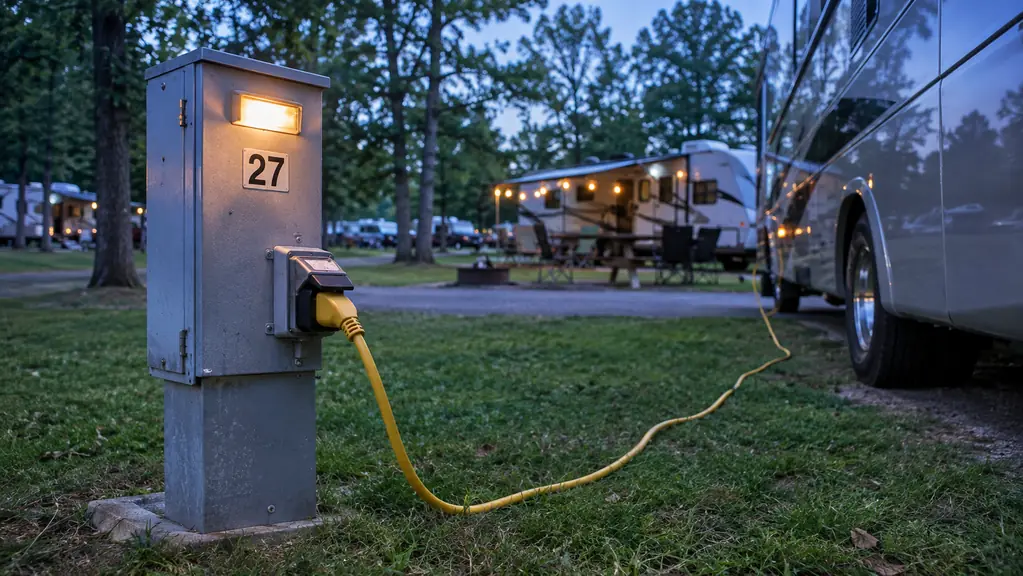
The indicator lights tell you which fault you have
There is a difference between knowing something is wrong and knowing what is wrong. The LED indicators on this one point at a specific condition, which is what turned a shrug into an actual conversation with the campground office in Arkansas. If we had been staring at an unlabeled box with one light on it, we would have plugged in and hoped. A specific reading is worth more than a vague warning, and this is the feature I use most.
We never learned what was wrong with that first pedestal in Arkansas. We never had to.
The weather shield assembly means rain does not change the plan
It comes with an all-weather shield assembly and a cover, and I have plugged ours in during a drizzle in New Mexico and during a properly wet spring afternoon in east Texas. I am not going to tell you it is waterproof to some standard I cannot name. I will tell you that weather is never the reason we skip it, and after three years of Texas and Arkansas weather, the housing has held up fine.
The locking bracket keeps it at your site
The box includes a locking bracket, and the reason that matters is simple. At a campground, anything loose at the pedestal is a thing somebody could pick up and walk away with. Ours stays attached where we put it. I like not thinking about it. I like it even more at a private park where the sites sit close together and people walk past your rig on the way to the bathhouse.
Thermal protection and a Lexan housing for a July afternoon
The listing mentions thermal protection and a Lexan housing built for harsh environments. July in east Texas is a fair test of that. Our protector has sat in full sun at two in the afternoon with the motorhome's air conditioner running and the pedestal in the open, and it has never given us any trouble. Three years, six trips a year, and nothing has cracked, warped or needed replacing.
It turns a judgment call into a habit
Here is the quiet benefit. Before we had it, plugging in was a guess. Now it is a sequence. Park, level, plug the protector into the pedestal, plug the shore cord into the protector, check the indicators, then go inside and start the coffee. Dean does it the same way every time. I do it the same way when I am the one outside. A habit you do not have to think about is worth more than a feature you have to remember.
What I'd Skip
The Progressive Industries SSP-30XL is a surge protector, not an electrical management system. If you want something that cuts the power when voltage drops too low or climbs too high, that is a different product at a different kind of cost, and we have never owned one. I have read enough listings to know the difference and I am not going to pretend this box does that job. What it does is sit at the pedestal, absorb a surge, and tell you what the outlet looks like before you trust it. For six trips a year on 30-amp hookups, that is what I wanted. I would also skip the adapter workarounds and the temptation to leave it in the bay because the weather looks fine. Ten seconds is ten seconds.
Ten seconds at the pedestal, every time you hook up
Our Progressive Industries SSP-30XL has ridden in the cord bag for three years and about eighteen trips. Rated 30 amp, 120 volts, 825 joules. It is a small thing to carry and the one item I would not travel without.
Amazon Check Today's Price on Amazon →