

Three years ago, before our first trip in the used 2019 Class C, I stood at a campground pedestal in East Texas with no idea what I was looking at. The breaker label was faded. The outlet had seen better days. Dean was behind the wheel, Biscuit was in her crate, and I was holding the RV power cord. That is when a neighbor walked over and asked if we had a Progressive Industries surge protector. We did not. We have one now, the SSP-30XL, and it has been plugged in at every hookup since.
This is not a lab test. It is a report from a 64-year-old retired school office manager who travels about six times a year with her husband and a 22-pound beagle mix. We stay four to ten nights at state parks and private RV parks in Texas, Oklahoma, Arkansas and New Mexico, mostly on 30-amp hookups. We bought the Progressive Industries SSP-30XL before our first trip, and we have never owned a hardwired electrical management system. What follows is what we have learned from using it, including the one time it told us something was wrong.
The Quick Verdict
A simple, well-built 30-amp safeguard that has earned its place in our setup, with one honest limit: it only helps if you actually read the indicator lights.
Amazon Check Today's Price →The Pedestal Does Not Always Tell the Truth. This Does.
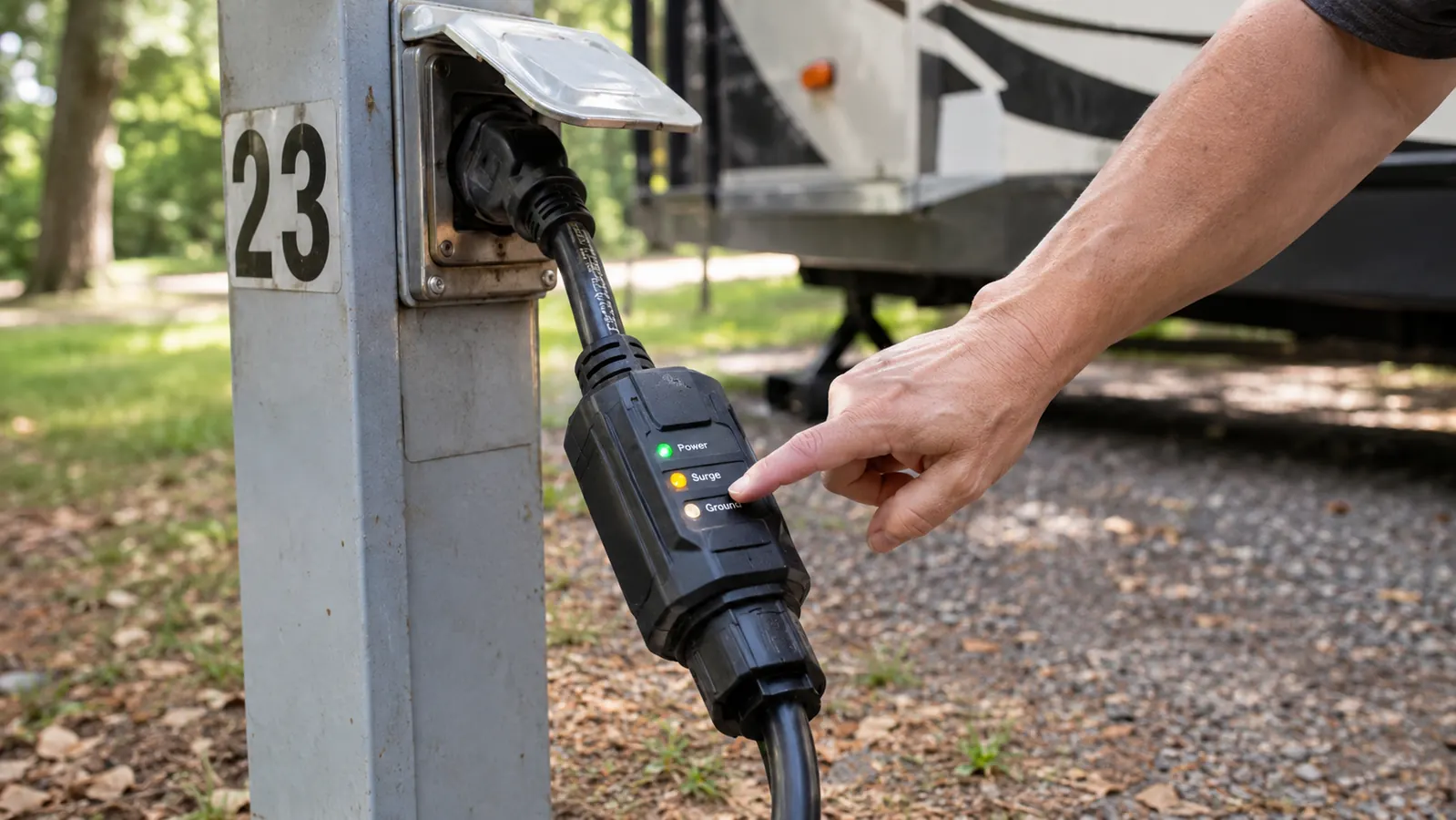
Plug the Progressive Industries SSP-30XL in first, check the indicator lights, then connect the RV cord. It is the first thing we do at every site.
Amazon Check Today's Price on Amazon →How I've Used It
We bought the SSP-30XL three years ago, the same week we bought the motorhome, before we had ever slept in it. A neighbor at that first park explained the routine: plug the protector into the pedestal, look at the lights, then plug the RV cord into the protector. Dean was skeptical. He thought it was one more thing to carry and one more connection to worry about. I was the one who wanted it, mostly because I did not want to learn about campground wiring by damaging something in our first used RV. It lives in the outside storage bay, and I can carry it in one hand. The listing puts it at 2 pounds and 14 inches long by 5.25 inches wide.
At every site, I do the same thing. I open the bay, take out the protector, and plug it into the pedestal. Then I look at the indicator lights. If everything reads the way it should, I plug the RV cord into it and turn on the breaker. If it does not, we stop. That is the whole routine. It takes less time than filling the water tank. On our trips we mostly use 30-amp service, which matches the unit. It is rated for 30 amp and 120 volts with a 3,600 W capacity. We have never used it on a 50-amp pedestal because our rig is a 30-amp rig.
What I did not expect was how much I would like having a thing to check. When you pull into a site after a long drive, you are tired and the dog wants out and the last thing you want is a mystery. The protector gives me one small, clear task before we settle in. That is worth something to me. It is not excitement. It is routine, and routine is what I want at a campground.
There is one more thing about the routine worth mentioning. The first time I used it, I stood at the pedestal for a good five minutes with the manual open, comparing the lights to the diagram. The campground host walked by and asked if I was all right. I was. I just wanted to be sure. Now the check takes me maybe twenty seconds. I plug in the protector, glance at the lights, and either wave Dean forward or shake my head. He watches me in the mirror. That headshake has happened exactly once.

What the SSP-30XL Actually Does at the Pedestal
The SSP-30XL sits between the campground pedestal and your RV power cord. That is its job. According to the listing, it is a portable 30-amp unit with a 120-volt rating, a 3,600 W capacity, and surge protection rated at 825 joules. It also lists thermal protection, a plastic enclosure with a Lexan housing, LED indicators, an all-weather shield assembly, a locking bracket, a cover, and a weather shield. I am not an electrician, so I will not pretend to explain the inside of it. I can tell you what it does in camp: it gives you a way to check the pedestal before your RV is connected to it.
The indicator lights are the part I use. They are simple, and that is both the strength and the limit. You have to look at them and know what they mean. The first few times, I kept the little card in the storage bay with the unit. Now I know the pattern I want to see. When the lights say the pedestal is fine, we plug in. When they do not, we do not. The listing calls the surge protection intelligent, but I cannot tell you what the unit is thinking. I can tell you it has been consistent.
It is also light enough and small enough that it does not become a chore. The housing is plastic, not heavy metal, and the weather shield assembly is part of the package. We use the shield when the pedestal is out in the open. The locking bracket is included, though I will be honest and say I am not the one who handles that part. Dean does. My job is the lights. His job is the cord and the breaker. After three years, we have a division of labor that works.
The cover matters more than I expected. When we are at a site with an exposed pedestal and the forecast has rain in it, I fit the cover over the connection and let the whole thing sit out overnight. The unit weighs 2 pounds, so it does not pull down on the plug the way something heavier would. I have also learned to set it on the plastic lid of the storage bin while I plug in, rather than in the dirt, because grit in the prongs is the kind of small annoyance that turns into a bad connection.
The Arkansas Pedestal That Read Wrong
In our second year, at a private RV park in Arkansas, the indicator lights showed a wiring fault at the pedestal. That is the one electrical incident we have had. I had not plugged the RV cord in yet. I went to the office and asked for a different site. The staff moved us without an argument. At the new pedestal, the lights read fine, we plugged in, and we stayed the night. Nothing in the RV was damaged. I cannot tell you what would have happened if we had plugged in anyway, because we did not.
It was a warm afternoon in October, the kind where you are still in shorts but the shade is a relief. We had driven in from a state park in Oklahoma that morning, and I was tired enough that I almost skipped the light check. I did not skip it. I plugged the protector in, looked down, and saw a pattern I had not seen before. Dean came around the side of the rig and asked what was wrong. I told him I did not know yet, which is not the answer a driver wants to hear after a long day on the road.
That is the whole story. No sparks, no drama, no fried appliances. Just a quiet warning that made us change sites. I know that is not the kind of story that sells a product. It is the kind of story that makes me trust one. The unit did not fix the pedestal. It did not make the campground wiring correct. It told us what it saw, and we acted on it. For our purposes, that is exactly what we bought it for.
I also learned something about myself. Before that trip, I might have plugged in and hoped. I am not naturally cautious with things I do not understand. Having a clear signal took the guesswork out of it. If the lights had read fine and something had gone wrong later, I would feel different. That is not what happened. We checked, we moved, and we went on with our trip.
Living With It: Setup, Storage, and Weather
The SSP-30XL lives in the outside storage bay beside the water hose and the leveling blocks. It is 2 pounds, so it does not need its own shelf. The 14-inch by 5.25-inch size is easy to slide into a gap. I like that it is portable and not wired into the RV. It means I can see it, check it, and put it away. It also means I have to remember to use it. That is the trade. A hardwired system would be out of sight and out of mind. This one asks for a small amount of attention every time.
Setup is not complicated. You plug it in, look at the lights, and plug the RV cord into it. The all-weather shield and cover are there for the times when the pedestal is exposed. We have used it in heat, in rain, and in the cold. I am not going to tell you it is indestructible. I am telling you ours has held up. The plastic enclosure has not cracked. The lights still work. The weather shield still fits. After three years and a few dozen hookups, that is what I can report.
On a cold morning in New Mexico, the plastic was stiff and the cord was stiff and everything took longer than it should. The protector still went in, the lights still came on, and we still got our coffee made. That is the level of performance I expect from a small plastic box, and it has met it. I wipe it down with a rag before it goes back in the bay, mostly to keep the dust out of the prongs, and I check that the cover is snapped on before I close the door.
The annoyance is the extra connection. You are already kneeling in the dirt to deal with the pedestal. Now you have one more plug to line up. In freezing rain, I would rather be inside with Biscuit. But the extra step is short, and the information is worth it to me. If you are the kind of camper who wants to plug in and be done, this unit will feel like a delay. If you are the kind who wants to know what you are plugging into, it will feel normal.
What It Does Not Do
It does not replace a hardwired electrical management system. We have never owned one, so I cannot compare the two from experience. I can tell you that this is a portable unit you plug in at the pedestal. If you want something installed inside the RV, this is not that. It also does not solve a bad pedestal. It tells you what it sees. You still have to ask for another site, wait for a repair, or move on. The unit gives you information. It does not give you a new campground.
It is also a 30-amp unit. If you have a 50-amp rig, this is the wrong product. Our Class C is a 30-amp rig, and that is why it works for us. If you are not sure what your rig uses, check before you buy. And it will not make a 30-amp site into a 50-amp site. It will not let you run more than the pedestal can supply. It is a safeguard, not an upgrade.
What I Liked
- Has a clear indicator-light check before you connect the RV
- Rated for 30 amp and 120 volts with 3,600 W capacity and 825 joules of surge protection
- All-weather shield assembly, cover, and locking bracket are included
- Light at 2 pounds and easy to store in the outside bay
- Has held up over three years of regular campground use
Where It Falls Short
- You have to look at the lights and learn what they mean
- Adds one more connection at every hookup
- Only for 30-amp rigs, not 50-amp service
- Does not replace a hardwired electrical management system
- No one is going to call kneeling at a pedestal in bad weather fun
In our second year, the indicator lights told us the pedestal was miswired. We moved sites. Nothing in the RV was damaged. That is the whole reason I keep it in the bay.
Who This Is For
This is for the RV owner who wants a simple check at the pedestal before the expensive stuff gets connected. If you have a 30-amp rig, if you stay at campgrounds with shared pedestals, and if you are willing to spend thirty seconds looking at indicator lights, the Progressive Industries SSP-30XL makes sense. It is also for the camper who does not want a hardwired project. You take it out of the bay, plug it in, and put it away. That is the whole relationship. For a retiree like me, who did not grow up with this equipment, that simplicity matters.
Who Should Skip It
Skip it if you have a 50-amp rig. Skip it if you already have a hardwired electrical management system you trust. Skip it if you know you will not check the lights, because the lights are the point. And skip it if you want a system that monitors everything from inside the RV with a remote display. This is not that. It is a portable 30-amp surge protector with indicator lights, and it does that one job without asking much of you. If that is what you need, it is easy to recommend.
Make the Pedestal Prove Itself Before You Plug In
Three years of trips, one wiring fault, and no damage to the RV. The Progressive Industries SSP-30XL is the first thing we connect at every site.
Amazon Check Today's Price on Amazon →