
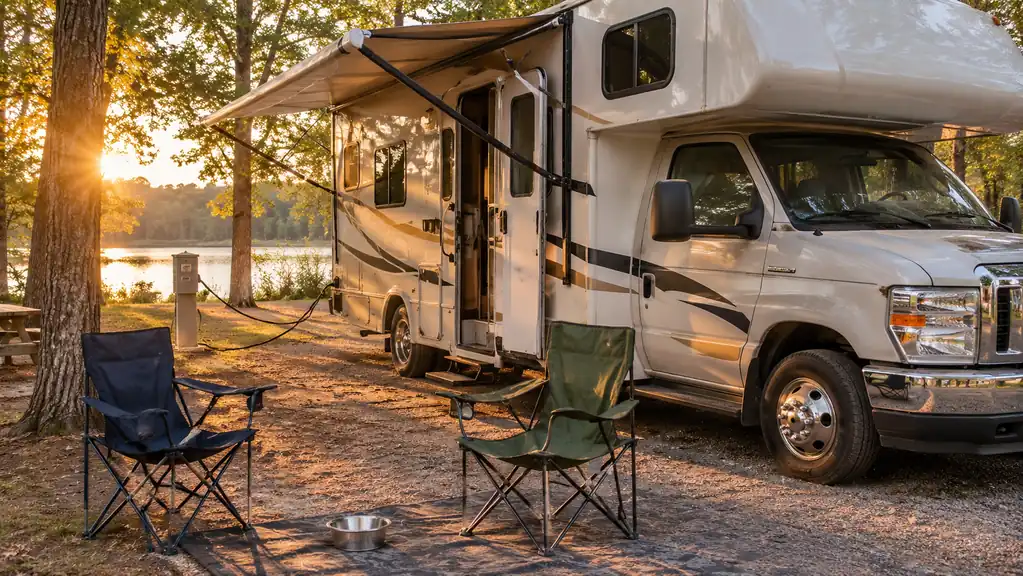
The first thing the seller told us about our used motorhome was not about the engine or the roof or the tires. It was about the power. Campground pedestals, he said, are not all wired the same, and some of them are not wired right at all. I nodded and pretended that made sense.
That was three years ago. The rig is a 2019 Class C, about 25 feet, and it is the first and only RV Dean and I have ever owned. Before it we tent-camped a handful of times and took a few cruises, and that was the sum of our travel education. I knew how to plug in a lamp. I did not know that a 30-amp outlet at a state park could hand your air conditioner more voltage than it was built for, or less.
Dean is the reader in our house. He came back from a week of evenings on forums with a decision: the Progressive Industries SSP-30XL, the portable 30-amp model. It is rated for 30 amps and 120 volts, 3,600 watts, and it absorbs surges up to 825 joules. It weighs two pounds and measures about 14 inches long by 5.25 inches wide, which you only care about once you are trying to find a home for it in the storage bay. We ordered it before our first trip.
I will be honest about my first reaction. It felt like an upsell. We had just bought a rig with its own long list of things to fix, and here was one more item on the list. What changed my mind was not a sales pitch. It was a man two sites over from us at a state park outside Athens, Texas, who mentioned, in the way campers do, that the pedestal at his last stop had been wired wrong, and that he now checks the power before he connects anything. I decided I would rather be the woman who checks.
We have plugged it in at every hookup since. That works out to about six trips a year, four to ten nights at a stretch, at state parks and private RV parks in Texas, Oklahoma, Arkansas and New Mexico. Nearly all of those sites have been 30-amp. Between trips it lives in the outside storage bay, through three Texas summers, and it still looks like the day it came out of the box.
The one time it mattered, it told us the pedestal was wrong before we ever plugged the motorhome into it.
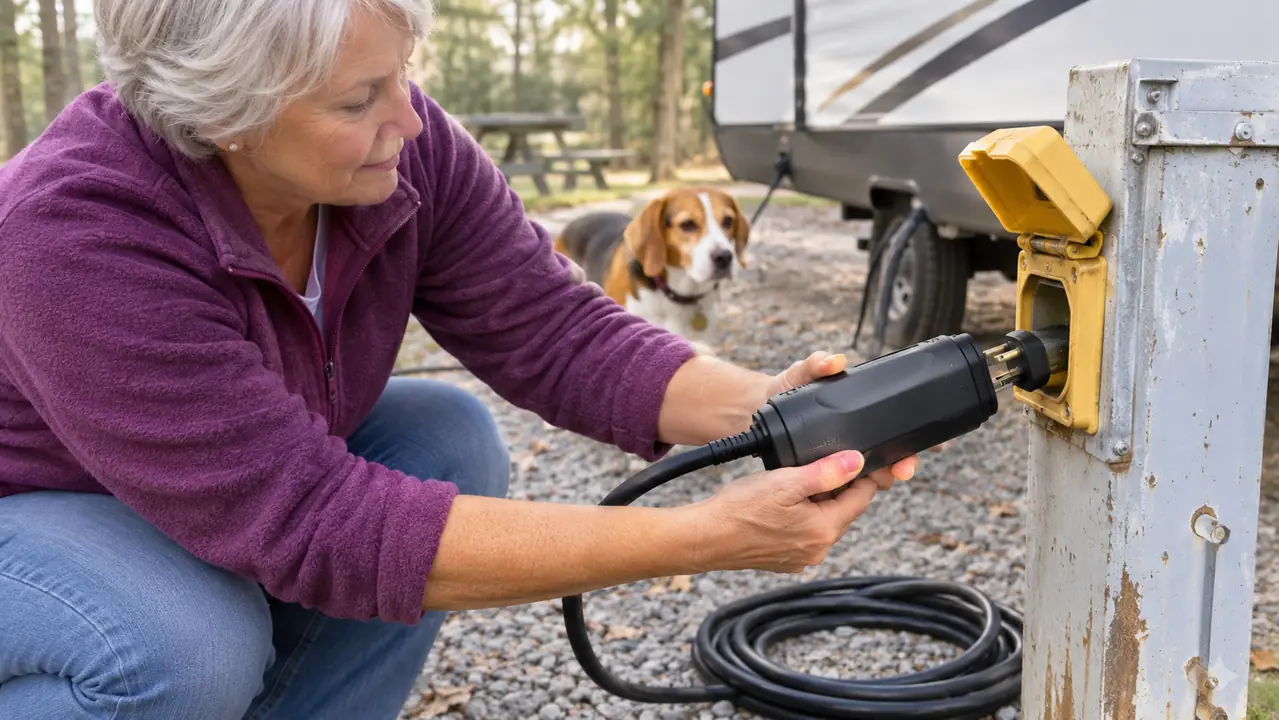
Here is the whole routine. Dean backs us in while I spot. I take the protector out of the bay, plug it into the campground pedestal, and plug the motorhome's own cord into the protector. Then I look at the LED indicators on the face of it before I go inside and turn anything on. That is the entire job, ten seconds if my hands are full. The value is not in what it does while you are asleep. It is in what it tells you in the first minute, before your refrigerator and your converter ever see that post.
The ten-second check I do before the motorhome ever touches the pedestal
The Progressive Industries SSP-30XL goes into the campground post and your RV cord goes into it. Rated 30 amps and 120 volts, 3,600 watts, absorbing surges up to 825 joules, two pounds, with a locking bracket, a cover and an all-weather shield. Three years of hookups and it is still the first thing out of the storage bay.
Amazon Check Today's Price on Amazon →
The second year is when I stopped thinking of it as an extra. We were at a private RV park in Arkansas, gravel pad, picnic table, not much else. I plugged the Progressive Industries unit in, looked down, and its indicator showed a wiring fault at the pedestal. I did not know what had gone wrong underground and I did not need to know. I walked to the office and asked for a different site. The new pedestal read clean and we stayed four nights. Nothing in our motorhome was damaged, that night or any other, and I would like to keep it that way.
I want to be exact about what this thing is, because I read enough forum arguments to know people blur the lines. The Progressive Industries SSP-30XL is a portable unit. You plug it into the post and your rig into it, so it protects the one circuit you are hooked to, which for us is the whole motorhome through its 30-amp cord. It is not a hardwired system mounted inside the rig. We have never owned one of those. It ships with a locking bracket, a cover and an all-weather shield, and the housing is a Lexan plastic that has taken three summers in a closed bay and one very wet week in Arkansas without complaint.
My complaints are small and honest. It is another foot of gear to store, and it rides in the same bay as the leveling blocks and the sewer bin, so I have to be deliberate about where I set it down. It is one more connection to make in the rain. And the lights are only worth anything if you actually look at them, which took me two trips to build into the routine.
None of this is glamorous, and that is the point. Biscuit, our beagle mix, does not care about voltage. She cares that the air conditioner runs, because a hot afternoon inside a metal box is miserable for a dog and miserable for me. The protector belongs in the same category as the water pressure regulator and the leveling blocks: unglamorous gear that quietly prevents a bad day.
What I'd Tell You If We Were Sitting at My Kitchen Table
I would tell you that nobody at a campground will ever be impressed by a surge protector, and that is exactly why the Progressive Industries SSP-30XL is worth having. It is not gear you show people. It is how you learn what the wiring is doing before it does something to your rig, and it is a layer between the post and your appliances when the post misbehaves. I would tell you to buy it before your first trip rather than after your first problem, because the after version usually means replacing something. And I would tell you the same thing I tell myself every time we pull in: look at the lights. The one night it earned its keep, the information was right there on the face of it, and it would have been easy to skip because I was tired and hungry and wanted to get supper started.
Buy it before your first trip, not after your first problem
Ours has ridden in the storage bay for three years and gone onto the pedestal at every hookup. Plug it in, read the indicators, then plug the motorhome in.
Amazon Check Today's Price on Amazon →