
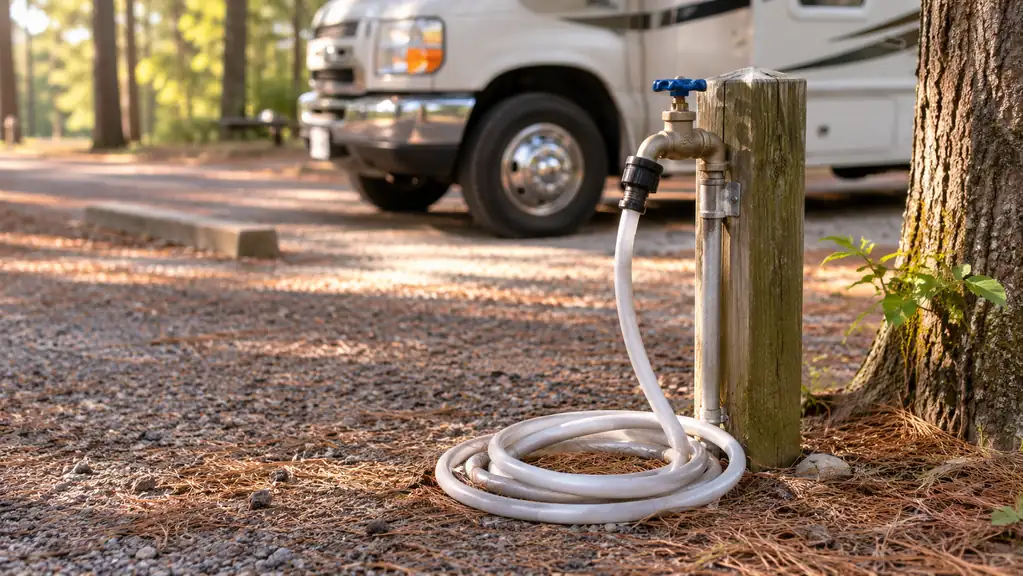
Three years ago I stood at a campsite spigot in East Texas with a drinking-water hose in one hand and a fitting about an inch long in the other, and I had no idea whether I was protecting our plumbing or buying something I would never think about again. The man who sold us our used Class C mentioned, almost in passing, that campground water pressure can run high enough to split a line. He said it the way people say things they assume you already know. We bought the Camco regulator that same week, and it has been screwed onto a spigot on every trip since.
This is the honest version of that purchase, not the version where everything is wonderful and nothing is complicated. A fixed regulator is a boring object, and most of what a buyer actually needs to know does not fit on the front of the package. It has no gauge. It has no dial. There is nothing to adjust and nothing to read, so you never really know what the pressure is at your site. After roughly eighteen trips across Texas, Oklahoma, Arkansas and New Mexico, I can tell you what that tradeoff feels like in practice, and who should not make it at all.
The Quick Verdict
A small preset fitting that does one job and never asks for attention. You give up knowing the number, and you get three years of not worrying about the pipes.
Amazon Check Today's Price →The inch-long fitting that has sat between our rig and every campground spigot for three years
Preset between 40 and 50 psi, drinking water safe, and small enough to live in the hose bag. Read the listing specs before your next trip.
Amazon Check Today's Price on Amazon →What Nobody Tells You Before You Buy One
The first thing nobody explains clearly enough is that this is a limiter, not a gauge. Camco lists a maximum operating pressure of 50 psi and describes the internal setting as preset between 40 and 50 psi. That means the water coming out of your faucet is capped, not measured. If the campground is running 110 psi, you get the regulated pressure and no warning that the spigot was running 110 psi. If the campground is running 35 psi, you get 35 psi, and you will spend the weekend blaming the regulator for a weak shower that was the campground's fault all along.
The second thing is that there is no feedback of any kind. Nothing clicks. Nothing moves. Nothing lights up. The only evidence that it is working is that nothing bad happens, and a quiet week of plumbing is a hard thing to feel triumphant about at the end of a long drive. I have had to train myself to treat an uneventful trip as the report card. That sounds like a small thing until you are standing at a spigot in the rain wondering whether the fitting is doing anything at all.
The third thing is size, which cuts both ways. The listing puts it at 1.8 ounces and one inch by one inch by one inch, and that is accurate in the hand. Small is good for storage and bad for keeping track of. Mine lives with the drinking-water hose now, because the one time I set it on a picnic table while I coiled the hose, I walked away and left it there. I caught it before we pulled out, but I understand exactly how one of these ends up staying behind at a site for the season.
How I've Used It
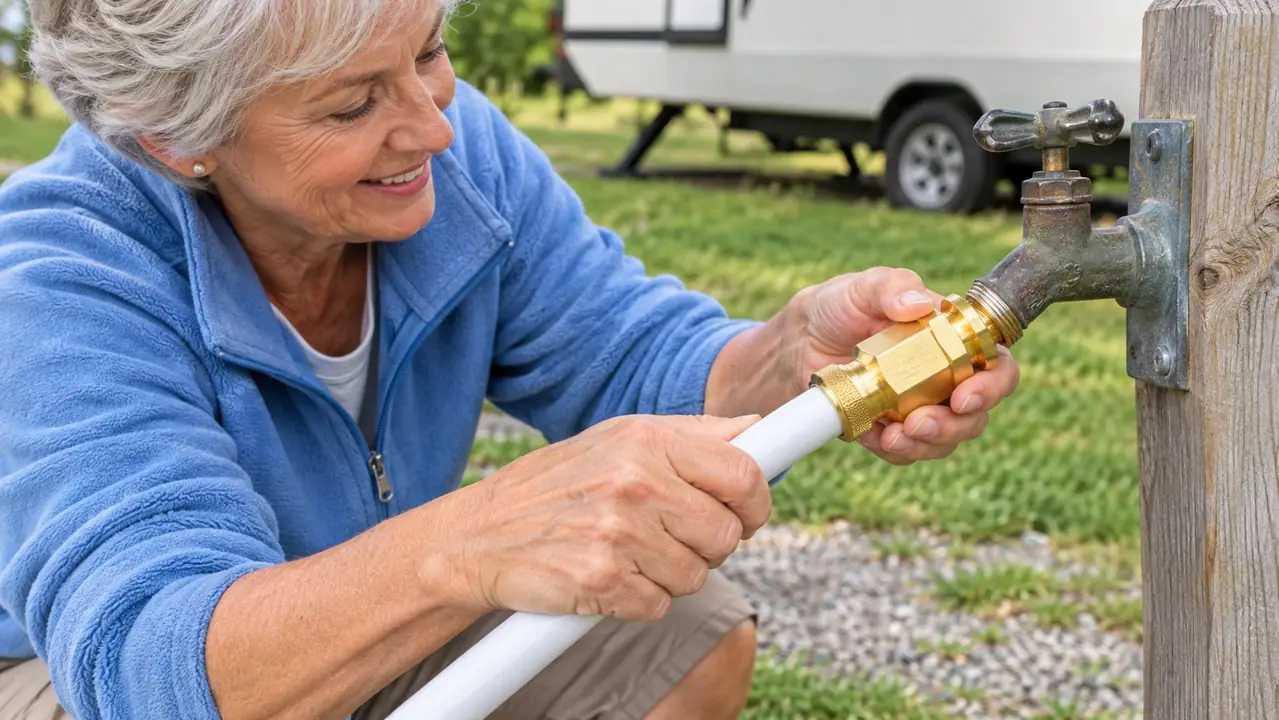
Our routine has not changed in three years. Dean pulls into the site, I take the water bag to the spigot, and the regulator goes on first. Hand tight, then one more snug turn with a small wrench so it does not weep. The drinking-water hose screws onto the other end. Only after that does anything reach the motorhome. It is the first connection in the chain and it stays there for the whole stay, including the days we are barely using water, because taking it off and putting it back on is more trouble than leaving it where it is.
The threads are 3/4 inch garden hose thread, which is the same thread as every campground spigot I have met and the same thread as our white hose. I have not needed an adapter and I have not had to force anything onto anything. The listing gives a female iron pipe inlet and an FIP outlet, and the body has come through three years of being dropped in gravel and rinsed off with the hose without pitting or seizing. It is not a pretty piece of gear. It is a piece of gear that has not given me a reason to replace it.
What I care about more than any of that is the certification line. Camco says the regulator is CSA certified lead free to NSF/ANSI 372 and compliant with federal and state level lead free rules, and that it is drinking water safe. We drink from the campground spigot through that hose, and we fill the onboard tank from it, so this matters more to me than the pressure number does. I am not a chemist and I am not going to pretend to audit the paperwork. I am a person who wants the listing to say what it says, plainly, before I run the water we drink through it.
The Specs, Translated Into Plain English
Here is the whole spec sheet in ordinary words. Maximum operating pressure 50 psi. Preset between 40 and 50 psi. 3/4 inch garden hose thread. Female iron pipe inlet, FIP outlet. Pressure relief valve body type. 1.8 ounces. One inch by one inch by one inch. Exterior finish listed as brass. Certified to NSF/ANSI 372 and CSA for lead free content. Limited one year warranty. That is the entire object, and there is nothing hiding in it.
Translated: it is a short threaded fitting that caps pressure and passes water through. It screws onto the spigot, your hose screws onto it, and the water that reaches your rig is limited to a range that most RV plumbing was built to handle. Nothing in that description is exciting and nothing in it is complicated. The entire value is that it is already set correctly when you take it out of the bag, and it will still be set correctly in five years, because there is nothing on it that can drift out of adjustment.
The one year limited warranty is shorter than I would like, and I would not build a purchase decision around it. If a fitting like this is wrong, you usually find out in the first few uses, when it weeps or will not hold. Ours is two years past that window and still does what it did on the first trip, which tells you more about the odds than the warranty language does. If it had failed in year one, I would have been on the phone. It did not fail, and I have stopped expecting it to.
Three Years of Campground Water
We stay at state parks and private parks, mostly on 30 amp hookups, four to ten nights at a stretch. The water has been different at every single one. Some spigots roar when you open them. Some trickle. A few have been stiff enough that I was glad the fitting, and not the hose, took the strain of the connection. In three years we have not had a burst line, a blown fitting, or a leak inside the motorhome. I do not think that is entirely luck, though I will be the first to admit I cannot prove otherwise.
I want to be careful about overclaiming, because this is the part of a review where writers get carried away. I cannot tell you the regulator saved our rig. We have never camped without it, so I have no comparison to offer and I am not going to invent one. What I can tell you is that the plumbing in a 2019 Class C is mostly plastic and quick connects, that the campgrounds we visit are not especially careful about pressure, and that this small fitting is the only thing standing between those two facts. That is enough for me.
There is a quieter benefit I did not expect. When we pull in after a long day, the site is tight, the light is going, and the spigot is stiff, I am not making a judgment call about whether to hook up. I hook up, because the decision was made three years ago and it costs me about thirty seconds. That is worth something to a couple in their sixties who would rather sit down with a cup of coffee than troubleshoot a water line in the dark after a five hour drive.

The Parts That Genuinely Annoyed Me
The lack of a gauge is my real complaint, and it is why this is not a five star item for me. I am the kind of person who likes to know the number. When a campground host warns that the pressure runs high, I would like to look down and see it for myself rather than take it on faith. Regulators with gauges exist, and if I were buying again I would at least look at one, though I would also expect one more thing to break. A gauge is a moving part and a lens, and this fitting has neither of those.
The second annoyance is the wrench turn. Hand tight is not quite enough at some spigots, and one extra snug turn with a small wrench stops the weeping. It takes thirty seconds and I do it every time, but it is one more step in a setup routine that already has a dozen of them. If you have grip or hand strength issues, plan for a pair of grips or ask your partner to snug it, because finger tight alone was not enough for us at maybe half the sites we visit.
The third is flow. Showers at low pressure sites feel a little softer with the regulator in line than they do without it. I have not measured that and I would not argue with anyone who says the difference is in my head. It is the tradeoff you accept when you choose a preset cap over an adjustable one, and on our six trips a year I will take the softer shower and the quiet pipes over the alternative every time.
What I Liked
- Preset between 40 and 50 psi, so there is nothing to adjust or fiddle with at the site
- Listed as drinking water safe and CSA certified lead free to NSF/ANSI 372
- 3/4 inch garden hose thread fits standard campground spigots and drinking-water hoses without an adapter
- 1.8 ounces and one inch by one inch by one inch, so it stores with the hose
- Three years of use with no leak, no seizing and no reason to replace it
Where It Falls Short
- No gauge, so you never know the actual pressure at your site
- It cannot be adjusted if a campground runs low pressure
- Needs a snug wrench turn at many spigots to stop weeping
- Small enough to leave behind on a spigot if you are not careful
- Softens flow a little at low pressure sites
Three years, roughly eighteen trips, four states, and the plumbing in our 2019 Class C has never had a burst line or a leak.
What I Would Tell You at the Next Site Over
If you were set up two sites down and asked me whether to buy one, I would ask you two questions first. Do you know what your rig's plumbing is rated for, and do you want to know the number at each site? If the answer to the second question is yes, I would point you at a gauge model and tell you to enjoy it, because you will not be happy with this one. If the answer is no, I would tell you to buy this fitting and stop thinking about the whole subject, because it is the simplest form of not thinking about it that I have found.
The other thing I would say is that this is not a filter. It does nothing about taste, smell or sediment. If the water at a park tastes like a swimming pool or runs cloudy for the first minute, a pressure regulator will not change that, and you should not expect it to. Pressure and water quality are two separate problems with two separate pieces of gear, and I have watched more than one neighbor at a campground blame the wrong one. Buy this for pressure. Shop separately for the rest.
Who This Is For
This is for the RVer who wants the water question handled once and then never thought about again. If you hook up at campgrounds a few times a year, if your rig is older or full of plastic fittings, and if you would rather not add another gauge to read and another decision to make at setup, this is the right shape of tool. It is also a sensible first purchase for a used motorhome, which is exactly how it ended up in ours, and it is the kind of thing you buy once and then forget about in the best way.
It suits people who are comfortable with a preset. You accept that the water will land somewhere in the 40 to 50 psi range when the campground is pushing harder than that, you accept that a weak site will feel weak, and you stop worrying about the number. If your idea of a good setup is fewer decisions rather than more data, this is the shape of gear you want in the water bag.
Who Should Skip It
Skip it if you want data. If you are the person who checks the pressure at every site, writes it in a notebook, and compares campgrounds by their water, a gauge regulator will make you much happier and this one will irritate you every time you bend down to hook up. Skip it, too, if you already run a whole rig filter and regulator combination that handles pressure upstream, because stacking another limiter in the line only costs you flow without adding protection you do not already have.
Skip it if you need adjustable pressure for a specific appliance or a rig with unusual plumbing, because this fitting gives you one preset range and no say in it. And skip it if you are the sort who loses small parts, unless you build the habit of clipping it to the hose the moment you unscrew it. I learned that habit the hard way, at a picnic table, in the rain, with the hose already coiled and the engine already running.
Three years, one small fitting, zero plumbing repairs
The Camco regulator is preset, drinking water safe and small enough to live with the hose. Check today's price and read the listing specs before your next trip.
Amazon Check Today's Price on Amazon →