
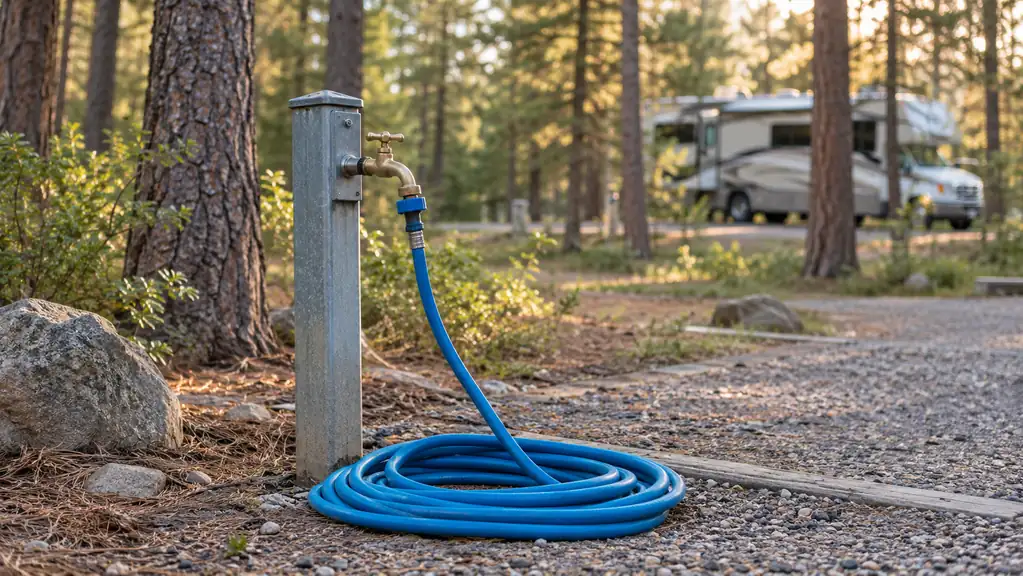
The short answer first, because that is what I wanted when I was standing in the aisle reading labels: these two pieces of gear are not competitors. The Camco brass water pressure regulator guards the plumbing inside your rig against a campground spigot that is pushing harder than your pipes want. A whole-RV water filter system cleans the water itself, so it tastes and smells like water instead of like the inside of a garden hose. Buy the regulator first. Almost every RVer should own one. Add the filter later, and only if the water at the parks you actually stay at gives you a reason.
Dean and I are not full-timers. We bought a used 2019 Class C motorhome about three years ago, roughly 25 feet, and we take it out maybe six times a year, four to ten nights at a stretch, mostly to state parks and private RV parks in Texas, Oklahoma, Arkansas and New Mexico. Biscuit, our beagle mix, comes along on every one of those trips. Most of the parks we stay at run 30-amp hookups and a shared water spigot at each site. That is the whole of our experience, and it is the experience I am writing from. We have owned the Camco regulator since the same week we bought the motorhome. We have never owned a whole-RV filter system. I have read the listings, asked questions, and listened to a neighbor at an RV park in Arkansas explain his for twenty minutes.
| Camco Water Pressure Regulator | Whole-RV Water Filter System | |
|---|---|---|
| What it does | Caps incoming water at a preset 40 to 50 PSI before it reaches the rig | Runs the water through a replaceable cartridge to cut sediment, taste and odor |
| Protects the plumbing | Yes. Preset at 40 to 50 PSI, with a maximum operating pressure of 50 psi | No. A filter housing does not regulate pressure at all |
| Improves taste and smell | No. It only controls how hard the water comes in | Yes. That is the entire point of the cartridge |
| Sediment and grit | Passes it straight through | Catches it before it reaches your faucet screens |
| Setup at the spigot | Thread it on, thread the hose on, done in about fifteen seconds | Can be plumbed into the bay once and never handled again |
| Upkeep | Nothing to replace, no cartridge, no schedule to remember | A cartridge on a replacement schedule, plus one more thing to pack |
| Space and weight | 1.8 ounces, about an inch in every direction, lives in the hose bin | A canister housing that takes up real room in the bay |
| Drinking water certification | Drinking water safe, CSA certified lead-free to NSF/ANSI 372 | Varies by unit, so read the listing for the cartridge you are buying |
| Best for | Any rig hooked to a park spigot, especially older plumbing | Repeated stays where the water itself tastes or looks wrong |
Where the Camco Regulator Wins
The regulator wins on the job it was built for, and it wins without asking anything of you. It is preset at 40 to 50 PSI with a maximum operating pressure of 50 psi, so there is no dial to turn and no gauge to watch. You screw it onto the campground spigot, screw the drinking-water hose onto the other end, and that is the entire procedure. The connections are 3/4 inch garden hose thread, there is a pressure relief valve built in, and the whole thing weighs 1.8 ounces. I have never once thought about it after the water was running.
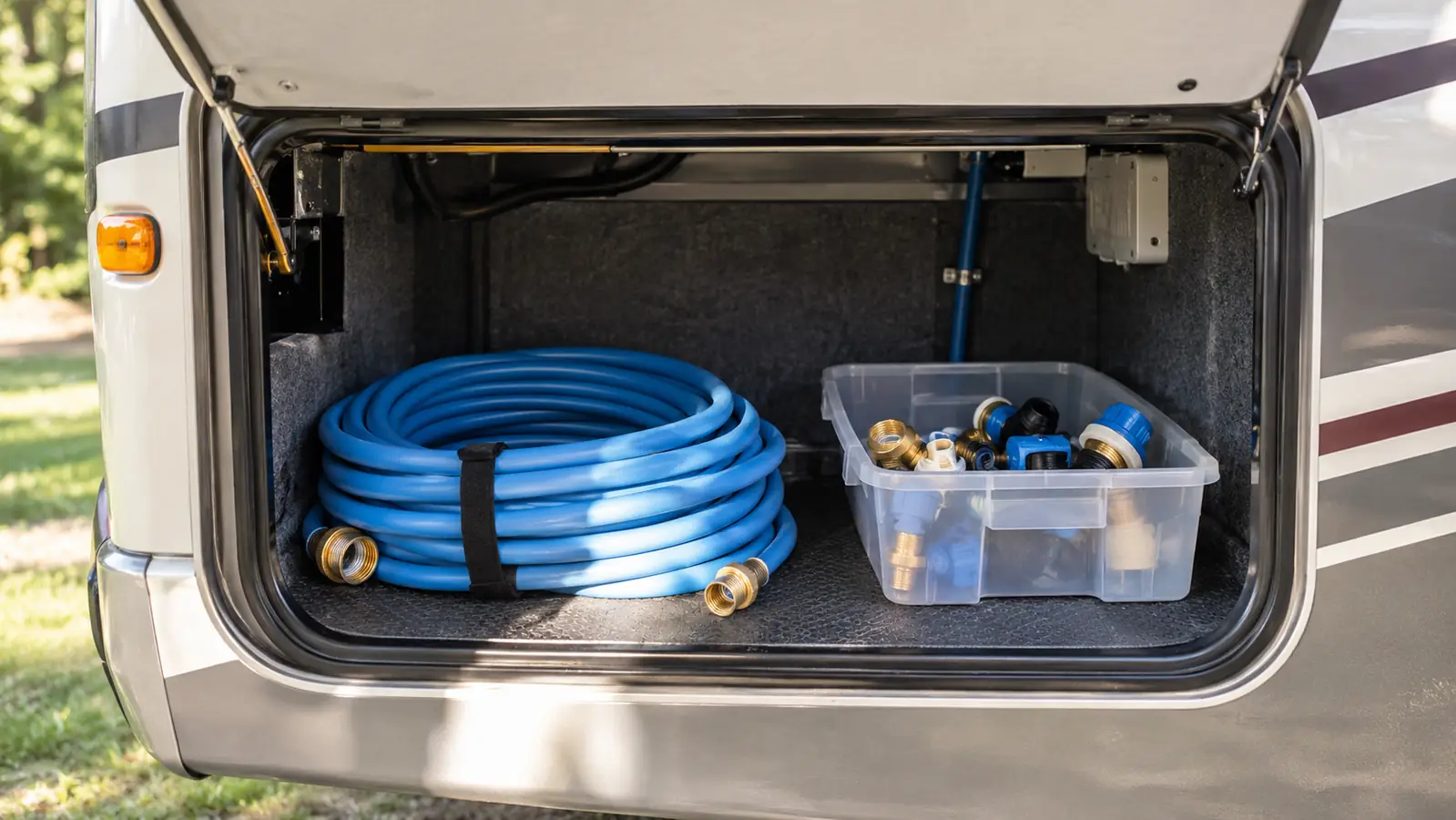
Second, it is small enough to disappear. Ours lives in a shoebox-sized bin in the outside storage bay with the drinking-water hose, and inside that bin it rides in a gallon zip bag with a marker label on the outside. The bag is not for protection. It is so the brass does not rattle against the hose fittings on the drive, and so I can find it in the dark without unpacking the whole bin at a wet gravel pad. It measures roughly an inch in every direction. In three years and somewhere around eighteen trips it has not leaked, not stuck, and not needed a part. The listing carries a limited one year warranty, which tells you what the manufacturer thinks of the wear, and the honest answer is that there is almost nothing on it to wear out.
Third, it is certified for what it touches. The Camco regulator is drinking water safe, CSA certified lead-free to NSF/ANSI 372, and compliant with the federal and state lead-free rules. That matters more than it sounds when the water is going into your coffee, your dog's bowl, and the pot you boil pasta in. I am not an engineer and I cannot audit a certification, but I can read a label, and this one says the things I want it to say.
Where a Whole-RV Water Filter System Wins
Now the other side, and it is a real side. A whole-RV water filter system does something the regulator cannot do at all: it treats the water. Most of them are a canister that holds a replaceable cartridge, and the cartridge is what removes sediment, grit, and the chlorine taste that makes campground water taste like a public pool. If you have ever filled a glass at a park spigot in west Texas in August and smelled it before you drank it, you know exactly what I am describing.
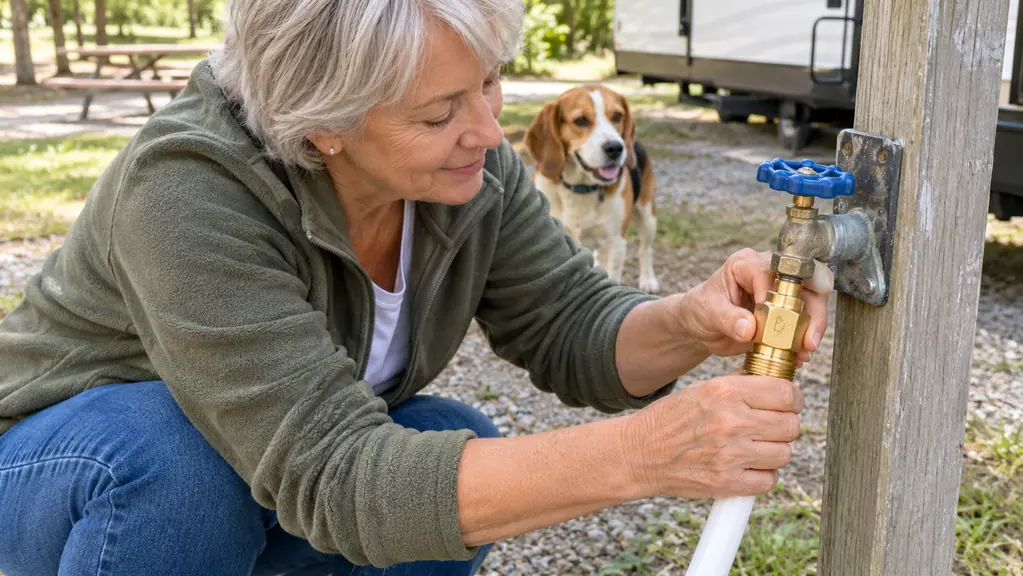
The second thing the filter wins is permanence. A whole-RV system can be mounted inside the water bay, plumbed in once, and then you never touch it at the spigot again. You show up, you connect the hose to the rig, and the filtering already happened. Our regulator, by contrast, comes out of the bin and gets threaded on at every single stop, on my knees in the gravel, sometimes in the rain. It takes fifteen seconds. I have done it in fifteen seconds a hundred times. But I would be lying if I said I never wished it were already done.
The water part I would buy again before my first trip
Preset at 40 to 50 PSI, no gauge, no dial, nothing to adjust. Drinking water safe and small enough to lose in the bottom of a storage bin. Three years of campground spigots and it has not leaked once.
Amazon Check Today's Price on Amazon →What the Regulator Actually Does at the Spigot
Here is the plain version, because it took me a season to understand it. Campground water systems are not all plumbed to the same pressure. A park at the bottom of a hill can be pushing water at a number your rig's plumbing was never built for, and the failure mode is not dramatic. It is a fitting that starts to weep, or a connection behind the shower that you do not find until the floor feels soft underfoot. The regulator sits between the spigot and your hose and caps what comes through at that preset 40 to 50 PSI. That is all it does. It is a bouncer at the door.
The clearest example I have is a park outside Nacogdoches, where the spigot sat at the top of a slope and the water came out hard enough that the hose straightened itself when I turned the handle. Our regulator went on first, the way it always does, and the flow at the kitchen faucet inside was the same lazy stream we get everywhere. That is the only test I know how to run. If the water inside the rig looks the same at every park, the regulator is doing its job and I do not have to think about it again for another year.
What it does not do is clean anything. It does not remove grit, it does not touch taste, and it does not filter sediment. If a park flushes its lines after a storm, the regulator will pass that cloudy water into your rig at a perfectly safe pressure and wish you well. That is not a flaw. It is a different job, and it is the reason these two products get talked about in the same breath when they really should not.
The regulator is a bouncer at the door. It decides how hard the water comes in. It does not care what the water is carrying.
One more thing about the regulator, because it surprised me. There is nothing to adjust, and that turns out to be the feature. I have watched people at campgrounds fiddle with adjustable regulators and gauges, hunting for a number they like, and I have never had to make a single decision with ours. It is preset, it is fixed, and the only maintenance is remembering to put it back in the bin before we pull out.
How We Ended Up With Just the Regulator
The seller handed us the regulator with the keys, the way a seller hands over a spare key and a story about the water pump. He said the pressure at some parks will split a fitting, and for very little he was not going to be the reason we found out the hard way. I did not think about it again for a year. Then we spent a week at a park where the spigot came out of the ground with visible force and the hose jumped when I turned it on, and I understood the transfer of property.
The filter conversation came later, at a park outside Hot Springs, when the water in our tank started tasting like a swimming pool and I blamed the tank for two days before a neighbor pointed out, gently, that the tank was full of park water. I had already drained and refilled the tank once, which is a forty-minute job I do not enjoy, and I had already decided the tank needed some kind of treatment. He had a filter canister bolted in his bay and a very settled air about him. I stood in his doorway and asked questions for twenty minutes and went back to our site meaning to buy one. Dean asked me on the walk back whether I was going to order it that night. I said I would look at it in the morning. That was two summers ago.
I have been meaning to for a while now. What stops me is not doubt about the product. It is the honest arithmetic of how often we fill from a spigot that tastes bad, which is maybe two trips out of six. When that number goes up, and it may now that we are wandering further west, I will buy the canister. Until then I will keep threading the regulator on in the gravel and being glad it is there.
What a Filter System Would Change at Our Kitchen Sink
If we added a whole-RV filter, the change I would notice first is at the sink, not at the spigot. The water we boil for coffee in the morning would stop tasting vaguely of hose. The ice would stop tasting like the inside of the freezer. Biscuit's water bowl gets filled from that same tap every morning before we walk her, and I have caught myself sniffing it before I set it down, which is not a thing I ever did before we started traveling. I have had campground water that was perfectly safe and still unpleasant, and a carbon cartridge is the thing that fixes unpleasant.
The change I would notice second is in the storage bay, and not in a good way. A filter housing takes real space, it needs a cartridge changed on somebody's schedule, and the cartridge is one more thing to buy and one more thing to remember before a trip. For a couple who goes out six times a year, that is a fair amount of upkeep for a problem that only shows up at certain parks. Which is why we have not bought one. Not because it is a bad product. Because the arithmetic of our particular trips does not demand it yet.
Who Should Buy Which
Buy the Camco regulator first if you are new to this, if your rig is older, or if you have never given a thought to what the park is pushing into your hose. It is the simplest insurance in the whole water conversation, it protects plumbing you cannot easily replace, and it costs you fifteen seconds per stop. Honestly, that is most people. It is certainly us.
Add a whole-RV filter system if the water where you stay is the problem rather than the pressure. That means you have smelled it, you have tasted it, you have found grit in the faucet screens, or you stay at the same handful of parks often enough that a permanent install in the bay makes sense. Full-timers, people with a fixed winter spot, and anyone filling a fresh tank from a questionable spigot will get real value out of one. People like us, at six trips a year, can wait.
Start with the fifteen-second fix, not the whole system
3/4 inch garden hose thread, drinking water safe, lead-free certified, and preset so there is nothing to adjust. It is the piece of water gear I would replace the same day if ours went missing.
Amazon Check Today's Price on Amazon →