
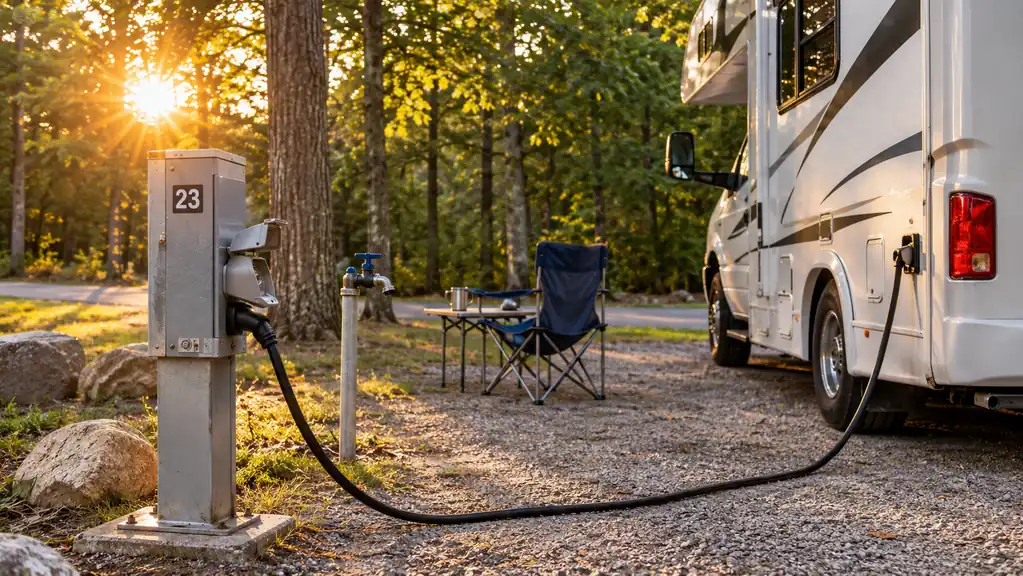
The first time Dean and I pulled our used Class C into a Texas state park, I did what most new owners do. I pushed the power cord into the post, flipped the breaker, and went inside to start supper. Nobody had told me that the outlet on a campground pedestal is not the same animal as the outlet in my kitchen. It is a connection to wiring I have never seen, put together by people I will never meet, and used hard by whoever pulled in before me.
That is the whole reason we bought a Progressive Industries SSP-30XL before our first trip, and why it comes out of the storage bay at every single hookup. It is a portable 30-amp surge protector, rated 120 volts and 3,600 watts, that absorbs surges up to 825 joules. It has LED indicators that tell you what a pedestal is doing before your motorhome finds out the hard way. We have run ours for three years, about six trips a year, almost all of them on 30-amp sites in Texas, Oklahoma, Arkansas and New Mexico.
What follows is the routine we actually use, in the order we use it. It takes about ninety seconds when nothing is wrong, and it has already saved us one site.
Check the post before your motorhome does
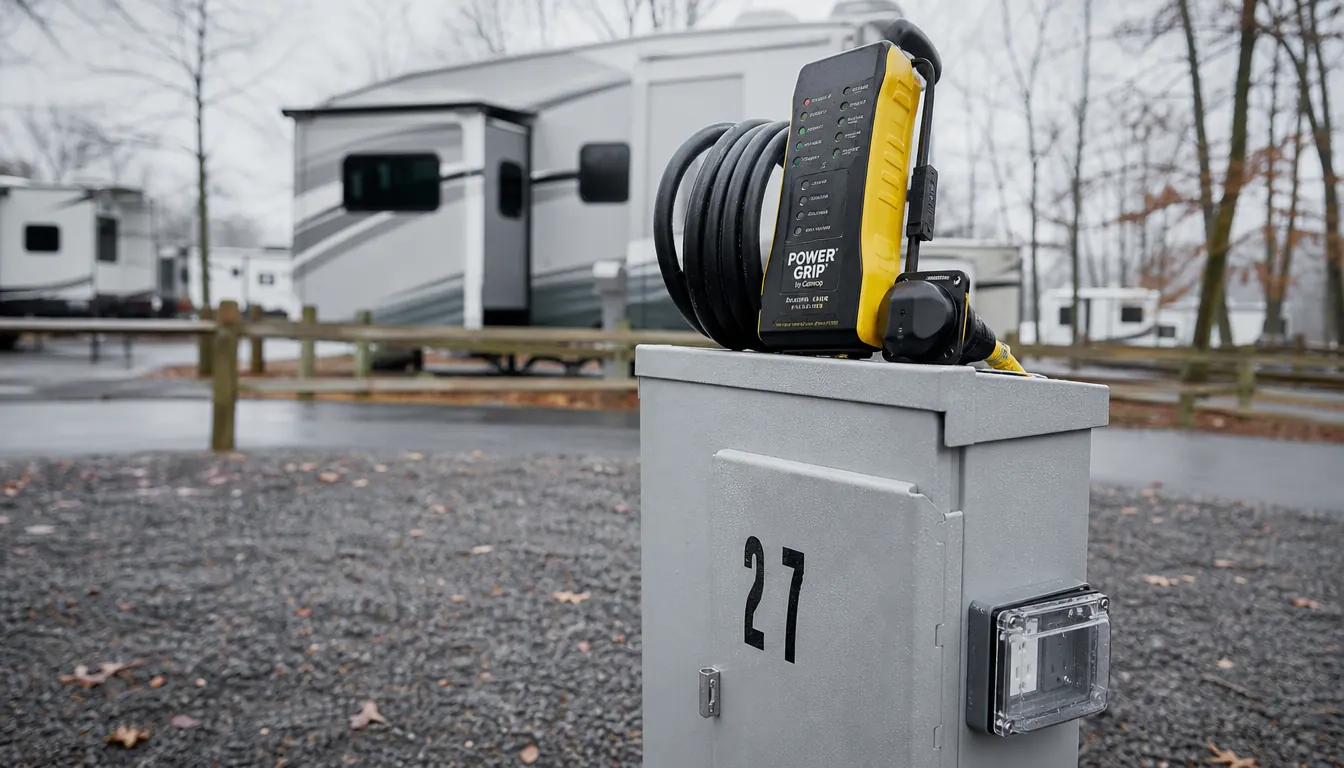
The Progressive Industries SSP-30XL sits between the pedestal and your cord: 30 amp, 120 volts, 3,600 watts, 825 joules of surge protection, with LED indicators, a locking bracket and an all-weather shield. Ours has gone on the post at every hookup for three years.
Amazon Check Today's Price on Amazon →The Five-Step Routine We Use at Every Pedestal
Step 1: Look at the post before you touch your cord
Before anything plugs in, look at the pedestal the way you would look at a rental car. Is the breaker switched off? Is the outlet face cracked, or loose in the box? Is there any scorching, or a smell of hot plastic, or water sitting in the bottom of the housing? Is the cover still attached, or has it been torn off and never replaced? Is the box leaning because somebody backed into it at least once?
Dean does this part while I stand with Biscuit on the leash and read the site number off the post. It sounds fussy until you have stood in front of a box that has clearly had a bad year. If the post looks beaten up, that is information, and it costs nothing to walk to the office and ask whether another site is open before you unhitch anything.
The other thing I do is switch the breaker off myself if it is not already off. That is not a feature of any product. It is just one less moment where the connection is live while my hands are near it and my attention is on the dog instead of the outlet.
Step 2: Plug the protector into the post first, then the RV cord into the protector
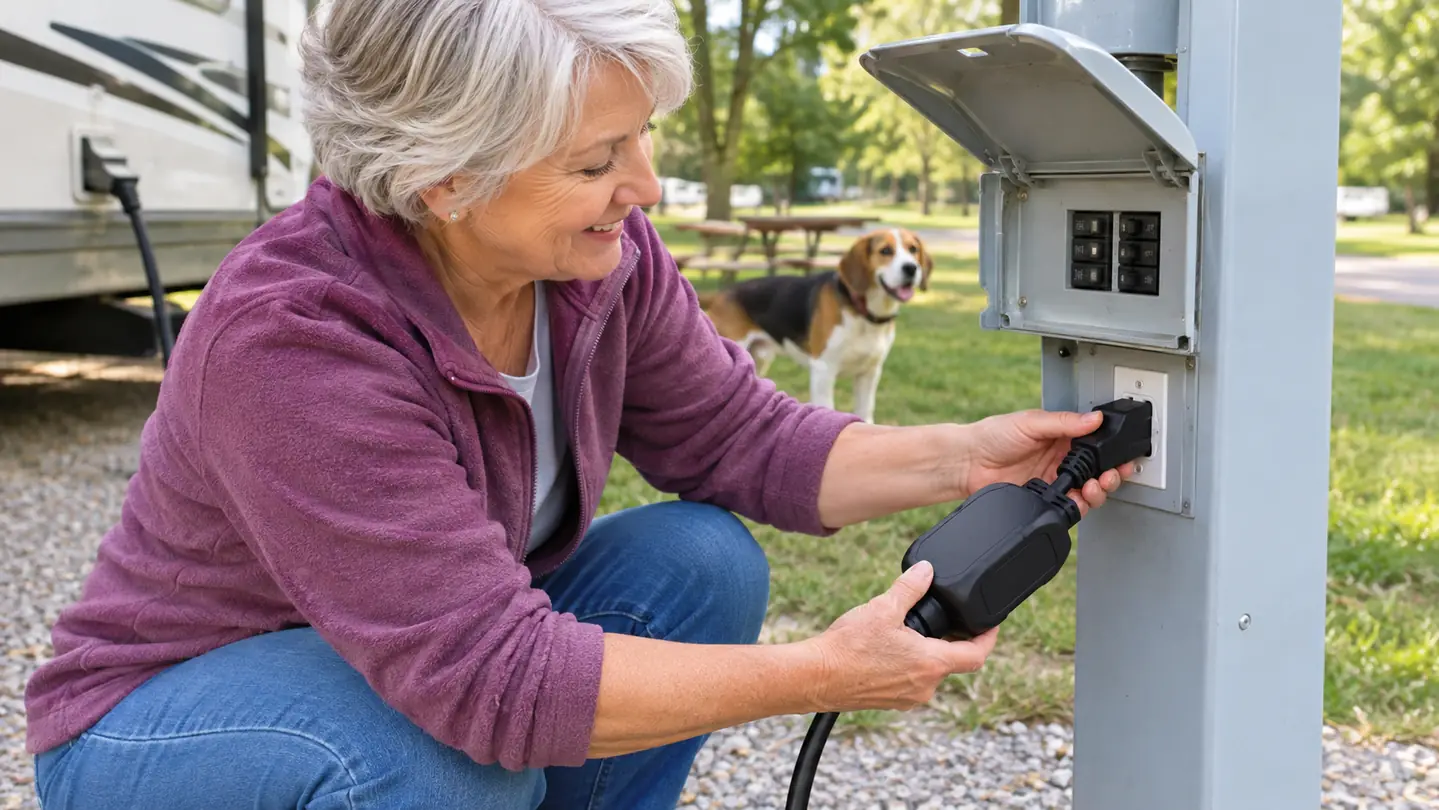
The order matters, and it is the part people get backwards. The surge protector goes onto the pedestal, and the motorhome's cord goes into the protector. The SSP-30XL is 14 inches long and 5.25 inches wide and weighs about 2 pounds, with a three-pin Type B plug on one end and the receptacle on the other. Seat the plug all the way in. Do not leave it half seated because the post is at an awkward height and you are in a hurry.
The housing is plastic, and the listing calls the material Lexan, which is the same family of stuff used for a lot of outdoor gear that gets dropped. It ships with a weather shield assembly and a cover, so the connection at the post is not sitting wide open to rain. We use the shield every time, even in dry weather, because a West Texas dust storm is its own kind of weather and I would rather rinse dust off than pick it out of a plug.
The 825-joule rating is the number people ask about most. Joules measure how much energy the unit can absorb in a surge before it gives up. It is not a number you can see or feel, and larger units on larger rigs exist. For a 25-foot Class C with a converter, a fridge and a coffee maker, this is what Progressive Industries rated this unit to handle, and it is the one we have run for three seasons of real trips.
Step 3: Read the indicator lights before you switch the breaker on
This is the step that earned the unit its permanent spot in the storage bay. Once the protector is on the post and the RV cord is seated in it, the LED indicators do the talking. You want those lights to tell you the pedestal is wired the way it should be before the breaker goes on and the converter starts pulling power through it.
In our second year, at a private park in Arkansas, the indicator showed a wiring fault at the pedestal. Not a maybe, not a flicker. A fault. We unplugged, walked to the office, explained what the light said, and asked for a different site. The second pedestal read clean. Nothing in the motorhome was damaged, because nothing in the motorhome had been connected to that post for longer than it took to read a light and say a word I will not repeat here.
I have heard the other version of that story from other campers, the one where somebody ignored the light because it was late and raining and they were tired. They spent the rest of the trip wondering why one outlet inside the coach acted strange. I would rather walk to the office in the rain. It is a shorter walk than the one to a repair shop in a town where you do not know anybody.
Step 4: Take the weight off the connection
A surge protector hanging by its own plug is a bad idea, and it is the mistake I notice most when I walk Biscuit around a loop in the evening. Two pounds does not sound like much until you add a stiff 30-amp cord hanging off it and cold weather that makes that cord stiffer still. All of that load lands on the outlet in the post, and the outlet is the part you cannot replace yourself.
The SSP-30XL comes with a locking bracket and a cover, and we use the bracket. It takes a minute to sort out the first time and about five seconds after that. When a post has nothing useful to attach to, we set the unit on top of the box or on a level block, whichever keeps the cord from pulling down on the plug. It is not elegant. It works.
The weather shield goes on at the same time, and the cover goes over the connection. The assembly is built to live outdoors. There is still a difference between outdoors and sitting in a puddle at the low end of a gravel pad where the whole site drains.
Step 5: Decide now what you will do when a light says no
The hard part of any of this is not the equipment. It is being tired and hungry and unhooking a cord in the rain because a little light told you to. So make the decision in advance, at your own kitchen table, where nothing is beeping at you. Our rule is simple. If the indicator shows a fault, the motorhome does not get plugged in. We take the site number to the office and ask to move.
Dean started photographing the site number with his phone the moment we pull in, which sounded silly to me the first time he did it. Then I was the one at the counter trying to describe which post we were on, and I stopped teasing him about it. The office staff can only help you if you can tell them where you are standing.
And if the park cannot move you, that is worth knowing before you settle in for the night. We have never had to leave a campground over a pedestal. We have also never plugged into one that a light told us was wrong, and I do not intend to start at 64.
What Else Helps
The surge protector only covers the electrical side, so I will mention the rest of our setup in one breath and then get back to the subject. Our Camco brass water pressure regulator screws onto the campground spigot before the drinking-water hose, because the seller told us three years ago that park pressure can run high and we never forgot it. It is preset, with no gauge and nothing to adjust, which suits me fine. We also try to arrive before dark when the drive allows it, and we keep the electrical connection and the water connection at opposite ends of our setup so nobody is stepping over a live cord to reach a spigot.
One more thing, and it is the sentence I would underline if I were handing this to a friend. The SSP-30XL does not fix a pedestal. It tells you what the pedestal is doing. If the news is bad, the answer is a different post, not a different gadget, and no amount of gear in your storage bay changes that.
A Word About 50-Amp Rigs
This unit is a 30-amp, 120-volt protector, which matches our coach and the pedestals we use. If you run a 50-amp motorhome, this is not the piece for you, and I would rather say so plainly than have somebody buy the wrong thing off a friendly article. Check your rig's connection type before you order anything, and if you are not sure, ask at the counter of the park you stay at most. Those folks know what the posts look like better than any listing does.
The indicator showed a wiring fault at the pedestal. We unplugged, walked to the office, and asked for a different site. Nothing in the motorhome was ever connected to that post for more than the time it took to read a light.
The Question I Get Asked Most
It usually comes out as some version of: does the motorhome not already have protection built in? Ours did not, at least not at the end of the cord where the power comes in, and I was not going to take a used 2019 coach on faith. Maybe yours does. Read your manual, or ask the previous owner, and find that out before you assume anything one way or the other.
The follow-up is whether a portable unit is as good as a hardwired one. I cannot answer that from experience, because we have never owned a hardwired system and I am not going to pretend otherwise. What I can tell you is that the portable one goes onto whatever post we happen to be standing at, stows in the storage bay in about the space of a shoebox, and has already earned its keep on one Arkansas afternoon. For a couple who camps six times a year in a 25-foot Class C, that is the whole argument.
Ninety seconds at the post is cheaper than a converter in a strange town
Thirty amp, 120 volts, 3,600 watts, 825 joules, LED indicators, locking bracket and weather shield. It is the same unit we have carried for three years and roughly eighteen trips.
Amazon Check Today's Price on Amazon →