
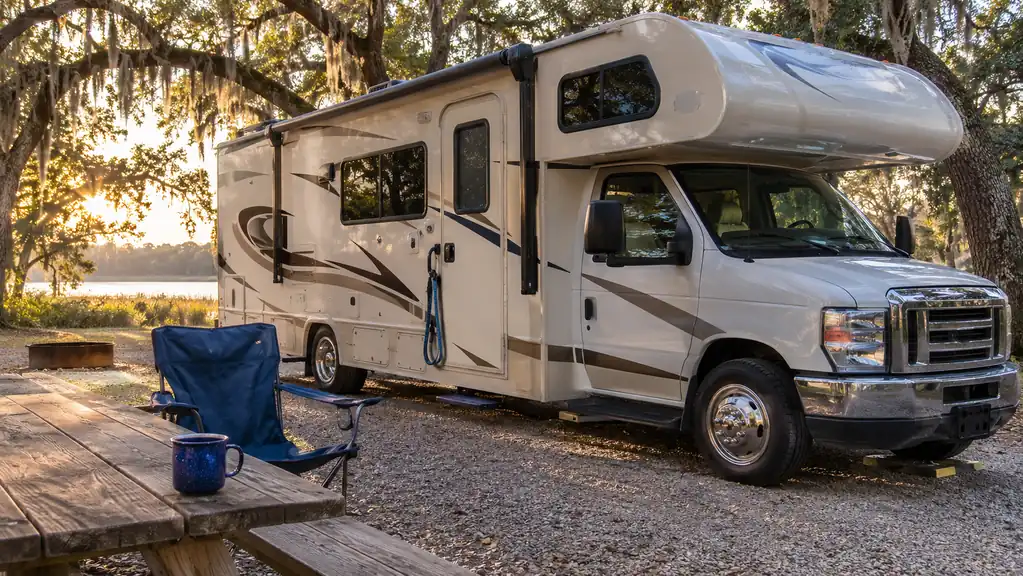
The first time Dean backed our 25-foot Class C motorhome into a site outside Ardmore, Oklahoma, it had rained that morning and the gravel was still wet. I stood at the rear corner with a flashlight while he wedged two scrap 2x8 boards under a back tire. He had cut those boards himself in the driveway in Tyler, and they were heavy and rough at the edges. The tire took the weight, the top board slid sideways on the wet gravel, and he had to pull forward and start over.
That was our first season. Twelve months of boards, a bubble level in the drawer, and a leveling app on my phone that never once agreed with the bubble. The coffee pot sat crooked and we laughed about it. What stopped being funny was the smaller stuff, like an entry door that needed a hip check to latch and a refrigerator that ran warmer on some sites than others. A woman two sites over from us in New Mexico, eleven years full-timing, watched Dean fuss with the boards and told me to stop making it hard on ourselves. Get a set of interlocking blocks, she said. Tri-Lynx has been making the Lynx Levelers in this country since 1992. I wrote the name on the back of a grocery receipt and stuck it in the console.
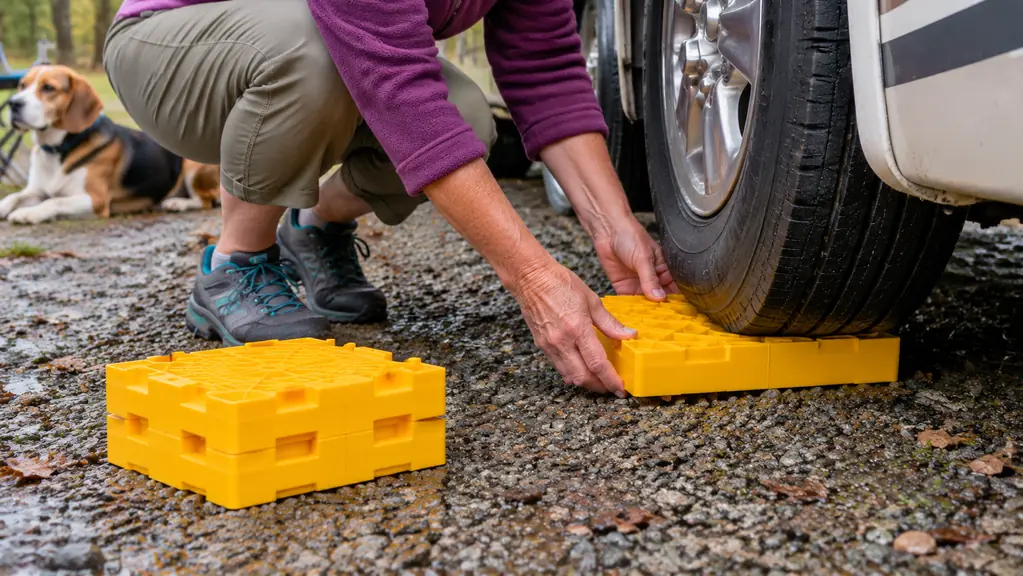
I ordered the 11-pack that fall, about two and a half years ago now. It came as ten interlocking blocks, one Lynx Cap level top, and a nylon storage bag with a handle. Each block is 8.5 by 8.5 by 1.5 inches, and one inch tall when two are interlocked. That detail sounds like nothing until you are standing in the dark doing arithmetic in your head. One inch per stacked layer is a number I can work with at seven in the evening.
The first site we used them on was a private park near Broken Bow, on a pad that sloped toward the road. Dean set two blocks at the low corner, put the cap on top, backed on, and stepped out. He looked at the bubble, then at me, and said nothing at all. That was the whole job. No sliding, no wet board spinning out from under the tire, no second attempt with me waving him forward two inches at a time.
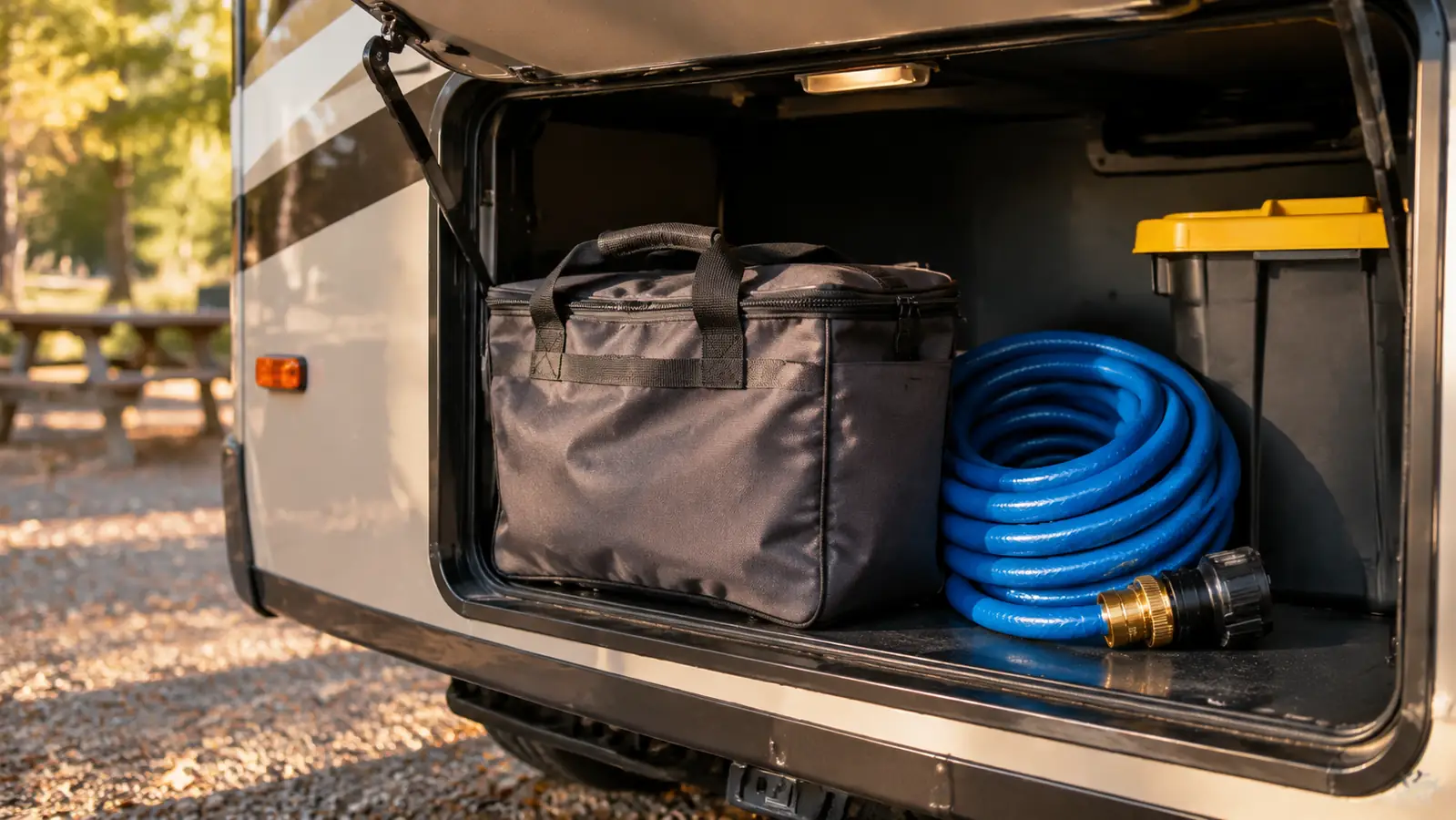
Two and a half years and something like fifteen trips later, they live in that bag in the outside storage bay, next to the water hose. Biscuit sniffs the bag on her way past it every single time we open that compartment. Nothing has cracked. Nothing has been lost. The boards went to the curb before our second season started and I have not missed them for one minute.
One inch per stacked layer is a number I can work with at seven in the evening, which is more than I could ever say for a wet 2x8.
The eleven pieces that ended our wet-gravel argument
Ten interlocking Lynx Leveler blocks, one Lynx Cap level top, and a nylon storage bag with a handle. Made in the USA by Tri-Lynx since 1992, and small enough to live in a storage bay without taking it over.
Amazon See the Lynx Levelers 11-Pack on Amazon →Here is how it actually goes now. You set the blocks in front of the tire, stacked to whatever height you need, and drive up onto them. Because they interlock, a stack behaves like one solid piece instead of three loose boards with their own opinions. The Lynx Cap goes on the top of the stack when you want a flat platform for the tire, and it only adds a quarter inch to the height when it is interlocked, so it never throws off the count I just did in my head.
Our motorhome has no leveling jacks. It never has. So this is not a backup to a push-button system, it is the system, and it has to work the first time at the end of a long drive. That is the honest reason I am fond of the thing. It is manual and dumb and it does exactly what I set it to do, and I can see with my own eyes what is happening under the tire.
What I Got Wrong at First
I underestimated how many blocks a real slope eats. Ten sounds like plenty until you meet a site with a genuine tilt, and then you are using six on one corner and wishing for two more. We still carry just the one 11-pack and it has covered every site we have taken, but on a couple of pads Dean stacked nearly everything we own under one wheel. If you routinely park on rough ground, know that the blocks go fast.
I also treated the bag as an afterthought for the first month, and that was a mistake. Blocks come back from a wet campsite with mud and grit in the interlocking joints. Tossing them loose in the bay means hunting for one when you need it. In the bag, they stay together, they stay out of the way of the hose, and I can carry the whole stack to the tire in one trip instead of three.
What I'd Tell You If We Were Sitting at My Kitchen Table
I would tell you that this is not an exciting purchase. Nobody stands around at a campground admiring their leveling blocks. What it buys you is the end of a small, repeated aggravation that shows up at every single arrival, usually when you are tired and the light is going. Dean and I are 64 and 66. We are not looking for a project at the end of a drive day. We are looking to be sitting in our chairs with the dog settled and nothing left to fiddle with. Level blocks do not make a trip. They take away one of the reasons a trip feels like work, and after two and a half years of not thinking about it, that is worth more to me than the price of a few boards. Take the advice the woman in New Mexico gave me, and put the name Tri-Lynx on the back of a receipt.
If your rig is still sitting on scrap lumber
The Lynx Levelers 11-pack is ten interlocking blocks, one Lynx Cap level top, and a nylon bag, rated 4.8 stars across more than nineteen thousand reviews. It is the least interesting thing in our storage bay and the one I would replace first.
Amazon Check Today's Price on Amazon →