
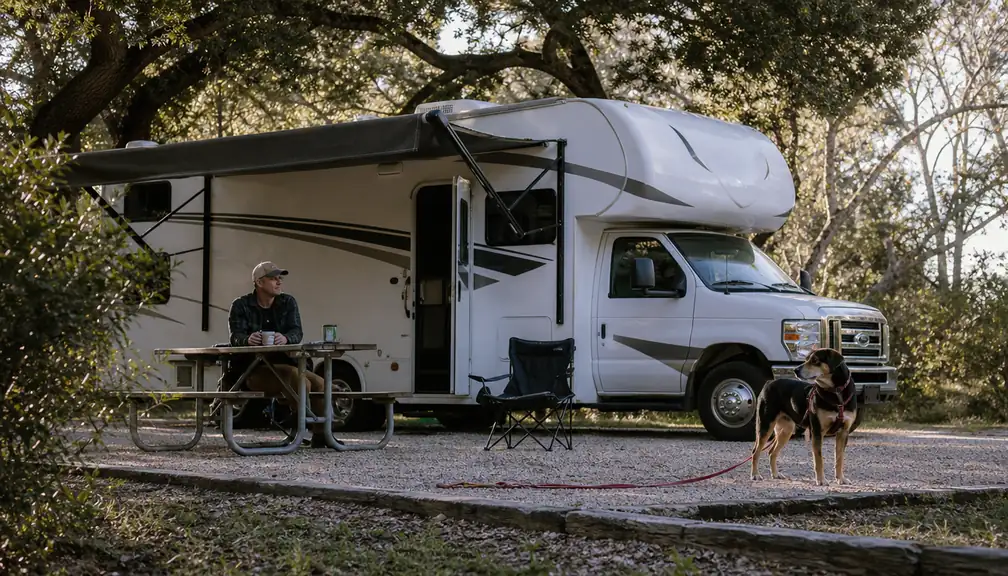
Six years of occasional tent camping did not prepare me for the first time Dean backed our motorhome onto a site that sloped toward the picnic table. He had four two-by-eight boards he had cut and sanded himself, a bubble level sitting on the floor inside the door, and me standing at the front tire saying a little more, a little more, stop. The boards worked. They also weighed more than I wanted to drag out of the bay at the end of a long travel day, and on wet gravel at a state park outside Nacogdoches one of them slid out from under the tire while he was still backing up. Nobody was hurt and nothing was damaged. I just did not like standing there watching it happen, and I did not like thinking about it on the drive home.
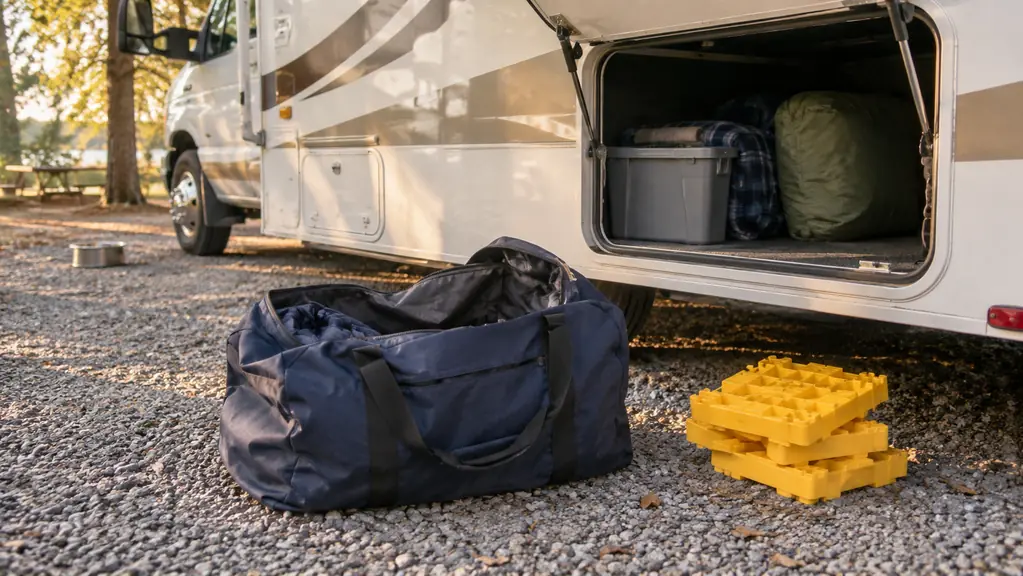
That winter, after our first season, I ordered the Lynx Levelers 11 pack from Tri-Lynx. Ten interlocking blocks, one Lynx Cap level top, and a nylon storage bag with a handle. The boards went out to the shed at home and have not traveled since. Two and a half years later, after something like fifteen trips across Texas, Oklahoma, Arkansas and New Mexico, I can tell you what the blocks solved, what they did not solve, and the one piece of the kit I did not expect to use as often as I do.
The Quick Verdict
Ten blocks and one cap in a bag that lives in the outside bay. Two and a half years of gravel, mud and one bad slope, and leveling stopped being the part of setup I stew about the night before.
Amazon Check Today's Price →The ten-block pack that retired Dean's scrap lumber
Ten interlocking blocks, one Lynx Cap level top, one storage bag. If your rig has no leveling jacks and you are still hauling boards, this is the swap that takes one afternoon to learn.
Amazon Check Today's Price on Amazon →How I've Used It
Our motorhome is a used 2019 Class C, about 25 feet, and it has no leveling jacks. That is the whole reason these blocks matter to us. When we pull into a site, Dean stops roughly where he wants the door to face and I walk the pad with the level in my hand, front to back and side to side. Then we decide which tire goes up and by how much. Most sites it is one front tire. Some sites it is a front and a rear on the same side. On two sites in New Mexico it was both fronts, and I remember both of them because I was tired and the wind was blowing and I wanted to be sitting down.
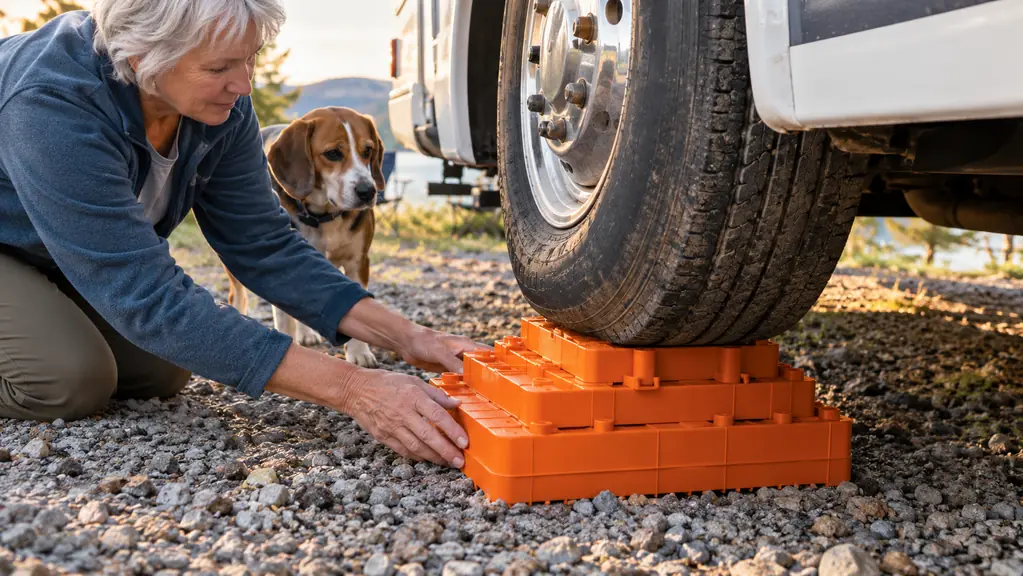
The blocks go where the tire is going to land, not where it currently is. That sounds obvious and I still got it wrong the first two times. You stack them, press them down so the nubs seat into the recesses, and then Dean rolls forward or back onto the stack slowly while I stand where he can see me in the mirror. Because the blocks interlock, a stack of three keeps its shape under the tire instead of squirting out sideways the way a wet board does. I have watched a board do that. It is the reason I went looking for something else in the first place, and it is the reason I stopped comparison shopping once I found the Tri-Lynx pack.
When we leave, the blocks come up, get knocked against the pad to shake the grit off, and go back into the bag in the outside storage bay. That is the whole routine. It runs about five minutes on a normal site, including the walk-around with the level. Before the blocks, setup took longer because we were dragging lumber out of the bay, stacking it by hand, and hoping it would not shift under the tire while Dean backed on. The bag also takes up less room than the boards did. It fits in a corner of the bay next to the drinking-water hose, and I can carry it with one hand.
How the Stack Actually Works
Each Tri-Lynx block is 8.5 inches square and 1.5 inches tall on its own. Stack a second one on top and it settles down into the first, so the pair adds about 2.5 inches of height instead of 3. Stack three and you are at roughly 3.5 inches. That nesting is the useful part. What you get is not a loose pile that shifts the moment a tire touches it, it is a stack that is locked together. I can build a three-high stack, set it on the gravel, and it stays a three-high stack while I walk back to the driver's window.
Ten blocks sounds like more than you need until you do the arithmetic on a real site. Three under the low front tire, three under the rear on the same side, and six are gone. A site that is low on one corner but not badly might take two and two. We have used all ten exactly once, at a private park in Arkansas where the pad fell away toward the road, and on that afternoon I was very glad the pack had ten in it. Most trips we use four and the rest ride along without complaint.
Tri-Lynx has been making these blocks in the United States since 1992, which is a fact I did not care about when I ordered and care about a little more now. There is nothing to adjust, nothing to inflate, and nothing with a battery that goes dead in the cold. Dean is the one in this marriage who likes gadgets. I like that these are not gadgets. They are plastic blocks that do one thing, and after two and a half years they still do it.
The Cap Is the Part People Overlook
The pack includes one Lynx Cap, which is a flat top that sits on the stack. It measures 8.5 inches square and half an inch thick, and because it interlocks like a block does, it adds about a quarter inch of height. A quarter inch does not sound like much until you are one block short of level and the bubble is floating just outside the lines. That is the exact gap the cap fills, and it fills it without you building a fourth block into the stack.
The cap also gives the tire a flat surface instead of the raised nubs of a block top. On gravel I do not think it matters much. On a concrete pad, with a tire that is going to sit in the same spot for a week, I like the flat top and I use it. It is also the piece I expected to lose first, because it is the smallest thing in the bag and it does not look important. It is still there. It stays in the bag with the blocks and I have not come close to leaving it behind.
Two and a Half Years Later
These blocks have been under our tires on gravel, dirt, sand, wet grass and one genuinely unpleasant mud site in Arkansas. They have scuffed edges and grit pressed into the seams. One block has a small nick where a rock sat under it on a site outside Tyler. None of them has cracked, crushed or lost its shape, and the handle on the storage bag is still attached, which is more than I can say for the tote we keep the sewer hose in.
What I notice most is what does not happen anymore. Dean does not get out and re-stack boards three times while I hold a level and try not to sound impatient. I do not lift anything heavy at the end of a nine-hour drive. The whole bag is light enough that I carry it with one hand, and I am sixty-four with a shoulder that files complaints in cold weather. If a product removes one small chore from every setup day, that is worth more to me than a product that adds a feature I have to learn.
They are not a cure for every site. On a pad with a hard side-to-side slope plus a front-to-back slope, you are building two stacks and doing the walk-around twice, and there is a point where I would rather ask the office for another site than build a tower. The cap handles a quarter inch. The blocks handle a few inches. Beyond that I stop working and go talk to somebody. That is not a knock on the blocks. It is a limit of anything that levels a rig by lifting a tire.
Where They Annoyed Me
The storage bag collects grit. Every few trips I turn it inside out over the gravel and shake it, and it is always worse than I expect. That is not the blocks' fault, it is what happens when you set things on the ground, but it is a chore the kit added and I would rather mention it than pretend it does not exist. A stiff brush would help. I keep meaning to put one in the bay and I keep not doing it, which tells you how small the problem actually is.
Counting is the other annoyance. Ten blocks, one cap, and nothing written on any of them, so at the end of a trip I am standing in the bay counting to ten before I close the door. Twice I have found a block under the picnic table where I set it down while doing something else. It is a small thing, and it is also the kind of small thing that matters, because the pack is sized for ten and losing one narrows what you can do on a bad site.
And if your rig has leveling jacks, do not buy these for leveling. I have watched neighbors push a button and be done before I have the bag open, and I am not going to pretend otherwise just because I like the blocks. That is a different tool for a different rig. A rig with jacks still rocks sometimes, and a couple of blocks under a stabilizer is not a bad use, but that is not the job I bought them for and I would not sell it to you as one.
What I Liked
- Interlocking blocks stay put under the tire, even on wet gravel
- Ten blocks plus the cap cover a genuinely bad site without a second purchase
- Light enough for one person to carry the whole bag
- Nothing to adjust, inflate or charge
- Made in the USA since 1992 and still in one piece after two and a half years
Where It Falls Short
- The storage bag collects grit and needs shaking out every few trips
- No markings on the blocks, so counting ten back into the bag is a chore
- Ten blocks will not fix a site with a hard slope in two directions
- Points to nothing if your rig already has leveling jacks
Three interlocked blocks lift a low tire about 3.5 inches. That is more correction than any site we have paid for has needed, and it takes about ninety seconds to build.
Who This Is For
If you drive a Class C, a travel trailer, a fifth wheel or a conversion van and you have no leveling jacks, this is the least expensive fix I know of and the one I would buy again tomorrow. It suits a couple where one person drives and one person spots, because the whole system depends on somebody standing outside watching the tire go up. It suits anybody who is tired of hauling lumber and tired of wet boards sliding on gravel while the neighbors pretend not to watch.
It also suits the person who does setup in the rain. Blocks that lock together are faster than boards that do not, and at the end of a travel day, in bad weather, that is worth more than it sounds like it should be. I have done the rain version with the old boards and I have done it with the Tri-Lynx blocks, and I know which one I would pick.
Who Should Skip It
If your motorhome has electric or hydraulic leveling jacks, skip these for leveling. You already own the better tool. I would not argue with keeping a few blocks around for a rig that rocks, but that is not the job I bought them for and I am not going to talk you into something you do not need.
If you only stay at paved resorts with dead-flat pads, you may never need more than two, and one of the ramp-style levelers might suit you better. And if you want something that levels the rig for you, these are not that. They are blocks. You still walk the site with a level and you still decide. What they do is make the deciding quick and the stacking stable, so you can be done and sitting down with a cup of coffee before the awning is all the way out.
Boards slide. Blocks lock.
Ten interlocking blocks, one Lynx Cap, one storage bag. Ours have lived in the outside bay for two and a half years and I have not once wished for the lumber back.
Amazon Check Today's Price on Amazon →