
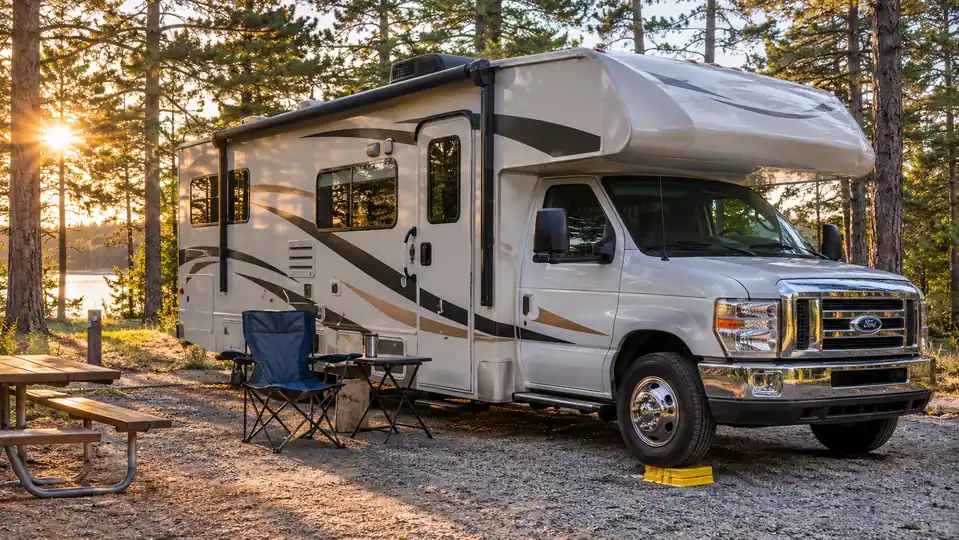
Our 2019 Class C motorhome has no leveling jacks. That is not a complaint, just the fact that sent us looking at blocks in the first place. For the last two and a half years we have used the Tri-Lynx Lynx Levelers 11 Pack, the set with ten interlocking blocks, one Lynx Cap, and a storage bag, and it has done the job on gravel, dirt, and a few sites that were more slope than pad. If you are comparing those blocks with electric leveling jacks, here is the short answer: the blocks are the simpler choice for a 25-foot rig without jacks. Electric jacks are the easier choice if the rig already has them and you level often. The rest of this is how we got to that answer.
We are Marla and Dean Pruitt. We travel about six times a year, mostly 4 to 10 nights at state parks and private RV parks in Texas, Oklahoma, Arkansas, and New Mexico, and our dog Biscuit rides along. We are not full-timers, and I am not an engineer. I say that because the electric jack question sounds technical, and for us it came down to a practical question: how much work do you want to do at the site, and how much hardware do you want on the rig? The Tri-Lynx blocks won that math for us. That does not mean they win for everyone, and I will get to the places where they do not.
| Lynx Levelers | Electric leveling jacks | |
|---|---|---|
| Cost to get started | Lower entry cost for a set of blocks, a cap, and a bag | Higher purchase cost, and mounted systems can add installation work |
| Installation | None. The set goes in the storage bay. | Usually mounted to the frame and tied into the rig's power |
| Setup time | Place blocks, back onto them, check the level, adjust if needed | Press a button and wait while the jacks raise the rig |
| Fine adjustment | Stack in 1-inch steps, with the cap adding 0.25 inch when interlocked | Powered jacks can make small corrections without moving the rig |
| Works without hookups | Yes, the blocks need no power | Needs the rig's battery or power system |
| Storage | Ten blocks, one cap, and a bag in the outside bay | Hardware stays on the frame or takes shop space if it is a portable set |
| Repair | If one block is damaged, replace that block | A motor, switch, or control problem can affect the whole system |
| Best for | A small Class C with no jacks and mixed campsites | A large rig that levels often and already has jacks |
Where Lynx Levelers Wins
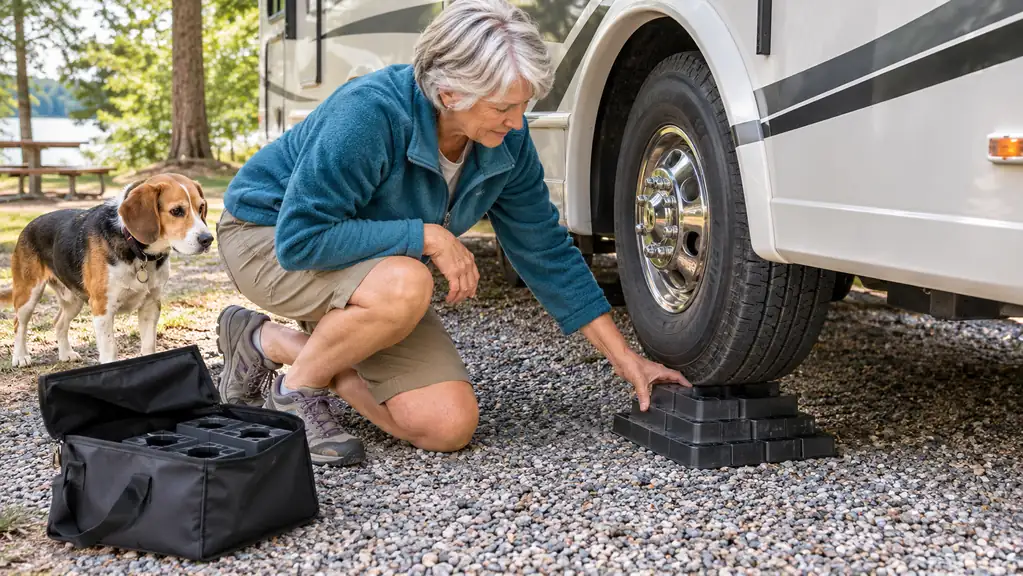
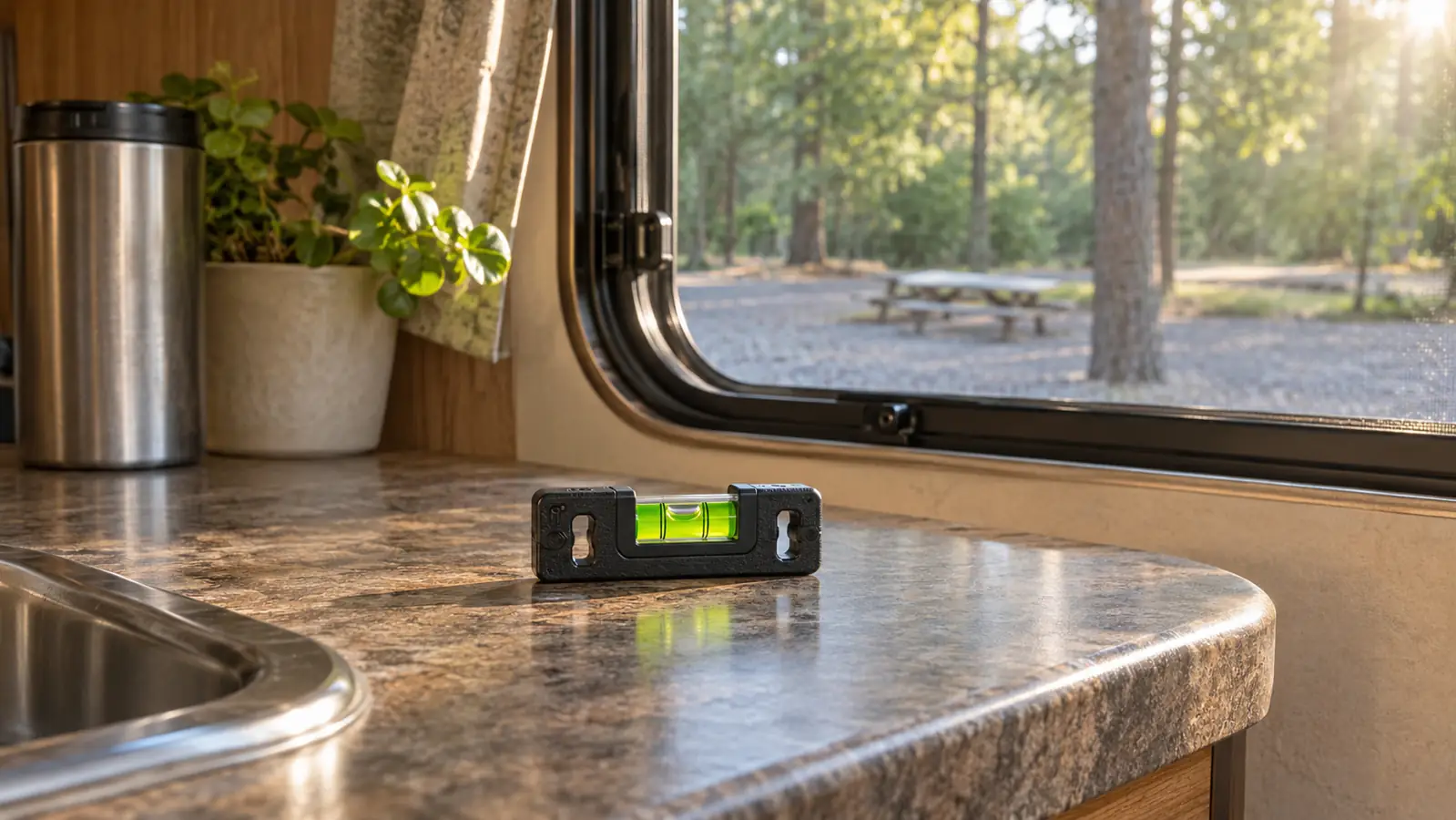
The first win is that the Tri-Lynx blocks do not ask anything of the rig. There is no motor, no switch, no wiring, and no control panel to learn. The listing says the blocks have been made in the USA since 1992, and ours have the plain, sturdy feel of a product that has not been changed just to look new in a catalog. I keep the bag in the outside storage bay, and it stays there. When we pull into a site, Dean walks the rig, I set the blocks where the front tire needs them, and he backs on slow. If the small level on the counter is off, we add a block or take one out. That is the whole system.
The second win is the range of places they work. A state park pad in Texas can be gravel, dirt, or a slab that is close but not close enough. The blocks do not care. They also do not care whether we have a 30-amp hookup or no hookup at all. The cap gives a flat top for the tire, and the listing says it adds 0.25 inch to the stack when interlocked. That small bit matters when a site is almost level and you do not want to go up a full inch. And if one block gets lost in the gravel, we are out one block, not a whole system. The 11 pack gives us ten blocks and the cap, so we have some room for a bad site.
One site comes back to me whenever this question comes up. We pulled into a state park outside Tyler on a Friday afternoon in October, and the pad sloped toward the door enough that the refrigerator door swung shut on its own. Dean backed onto two blocks under the front right tire, and the door stayed where I put it. That took about four minutes, including the walk-around. We have had sites where I used three blocks plus the cap and still asked Dean to pull forward six inches and try a better spot. The blocks let us do that without calling the office or waiting on anything to cycle. You stack, you look at the level on the counter, and you either add one or you do not.
Where Electric Leveling Jacks Wins
I will not pretend the blocks are easier on the back. They are not. Electric leveling jacks win on the part of setup that hurts. A neighbor at a park in Texas has a larger rig with jacks, and I have watched him press a button, step out, and wait. The rig raises itself, he checks a level, and he is done. No kneeling in gravel. No backing on and off a stack. If it is raining or the site is tight, that convenience is real. If I leveled every day, or if Dean and I were full-timers, I would care about that more than I care about the simplicity of blocks.
Electric jacks also win on fine adjustment. With blocks, you are working in 1-inch steps, plus the 0.25 inch from the cap. If the site needs a half inch, you may end up adding the cap and calling it close, or moving the rig. Powered jacks can make small corrections without moving the coach. That is a genuine advantage. The catch is that the advantage comes with hardware that has to be installed, powered, maintained, and repaired. We have never owned electric jacks, so my view comes from listings and from watching neighbors, not from living with a system for years. From what I can see, it is not a thing you toss in the bay and forget.
For a 25-Foot Class C With No Jacks, the Tri-Lynx Set Is the Simple Fix
Ten blocks, one cap, and a storage bag. No wiring, no control panel, and no power draw. That is why we keep ours in the bay.
Amazon Check Today's Price on Amazon →What Two and a Half Years With the Blocks Has Taught Us
We bought the 11 pack after our first season, when Dean's scrap 2x8 boards were still in the bay. The boards were heavy, and they slid on wet gravel. He cut them himself, and he was proud of them, but neither of us liked wrestling them out of the compartment. The Tri-Lynx blocks are lighter, and they interlock. That sounds like a small thing until you are trying to stack a level base while Biscuit is whining at the end of her leash and the light is going. The blocks made that job smaller. They did not make it disappear.
The first month, I did not trust them. Dean and I would stand there and debate whether the stack was lined up before he backed on, and once he came in crooked and the top block slid out from under the tire. Nothing broke. We picked it up, brushed off the gravel, and tried again. What I learned is that the blocks want to be pushed together until they seat, not stacked like pancakes. Once I started doing that, the stacks stopped sliding. It is one of those small habits nobody hands you in the manual, and I picked it up in a wet gravel loop at a park in Arkansas with the engine idling.
Our rig is a used 2019 Class C, about 25 feet. It does not have leveling jacks, and we have never added them. That is the main reason the blocks make sense for us. An electric system would be a major addition to a motorhome this size, and we would be adding it to solve a problem that a bag of blocks already solves. If our rig had come with jacks, I suspect I would use them and keep the blocks for the odd site where the jacks run out of lift. But it did not, and I am not going to spend a season's travel budget on hardware we do not need.
The blocks are not a cure for a bad site. On a heavy slope, we may need two blocks under one tire and none under another. The stack can shift if we back on too fast. Dean has learned to go slow and to stop when I hold up a hand. I have learned to put the cap on top when we need a flat surface, and to check the level after we are parked, not just before. The first few times, we made it harder than it needed to be. Now it is a five-minute job on most sites, and a ten-minute job on the bad ones.
The cap is the piece I did not understand at first. It is 8.5 by 8.5 by 0.5 inches, and the listing says it adds just 0.25 inch to the stack when interlocked. It gives the tire a flat top and keeps the stack from digging into the tread. I use it most on gravel. The storage bag is not a luxury either. Before, the boards lived loose in the bay and sawed against everything. Now the blocks go in the bag, the bag goes in the bay, and I can find them in the dark.
The blocks did not make us level faster than a button. They made us level without adding a whole system to the rig.
The Questions We Asked Before Choosing
The first question was whether our rig already had jacks. It did not. That pushed us toward blocks. The second was how often we level. We do it about six trips a year, and some of those sites are close to flat. That is not enough use to justify a mounted system. The third was where we camp. We are in state parks and private parks, mostly on 30-amp hookups, and we are not crawling over rocks in a lifted rig. The blocks fit that kind of travel.
The fourth question was power. We have a house battery and a 30-amp hookup, but I like gear that works when the power is off or the battery is low. The blocks do not care. The fifth was storage. Our outside bay is not huge. Ten blocks, one cap, and a bag take up less room than a portable electric set would, and they do not need a mounting point. The sixth was repair. If a block cracks, I can replace it. If an electric jack fails, I am looking for a shop.
There was also the question of rain, which nobody mentions until you have lived it. Blocks get wet and gravel sticks to them, and ours go back in the bag damp more often than not. When we get home I dump the bag on the picnic table and let everything dry in the sun before it goes back in the bay. That is a chore and I will not dress it up. It takes five minutes and it keeps the compartment from smelling like a wet driveway. An electric jack never asks that of you, because there is nothing to carry in and nothing to dry out.
The last question was the one I did not want to ask. Am I willing to kneel in the gravel? The answer is yes, for a few minutes, a few times a trip. If the answer had been no, I would have looked harder at electric jacks or at a rig that already had them. That is the honest line between the two choices. It is not about which product is better in every way. It is about which kind of work you are willing to trade for which kind of convenience.
Who Should Buy Which
Buy the Tri-Lynx Lynx Levelers 11 Pack if your rig has no leveling jacks, if you level a few times a trip, and if you want a simple set that lives in the storage bay and needs no power. It is also the right pick if you camp in places where the pad is gravel or dirt and you want to stack in 1-inch steps. Look at electric leveling jacks if your rig already has them, if you are in a larger coach, or if you level often enough that the button is worth the hardware. For us, in a 25-foot Class C with Biscuit in the back and a site waiting, the blocks are the choice we would make again.
If you are still undecided, ask yourself one question on your next trip. When the site turns out to be off-level, do you want to walk around the coach with a bag in your hand, or do you want to stand still and press something? There is no wrong answer here. There is only the answer that matches the rig you own and the knees you have. Ours matched the bag, and two and a half years later I still have not regretted it.
The Set We Keep in the Bay, Trip After Trip
Ten blocks, one cap, a storage bag, and no power draw. If your rig is like ours, that is enough.
Amazon Check Today's Price on Amazon →