

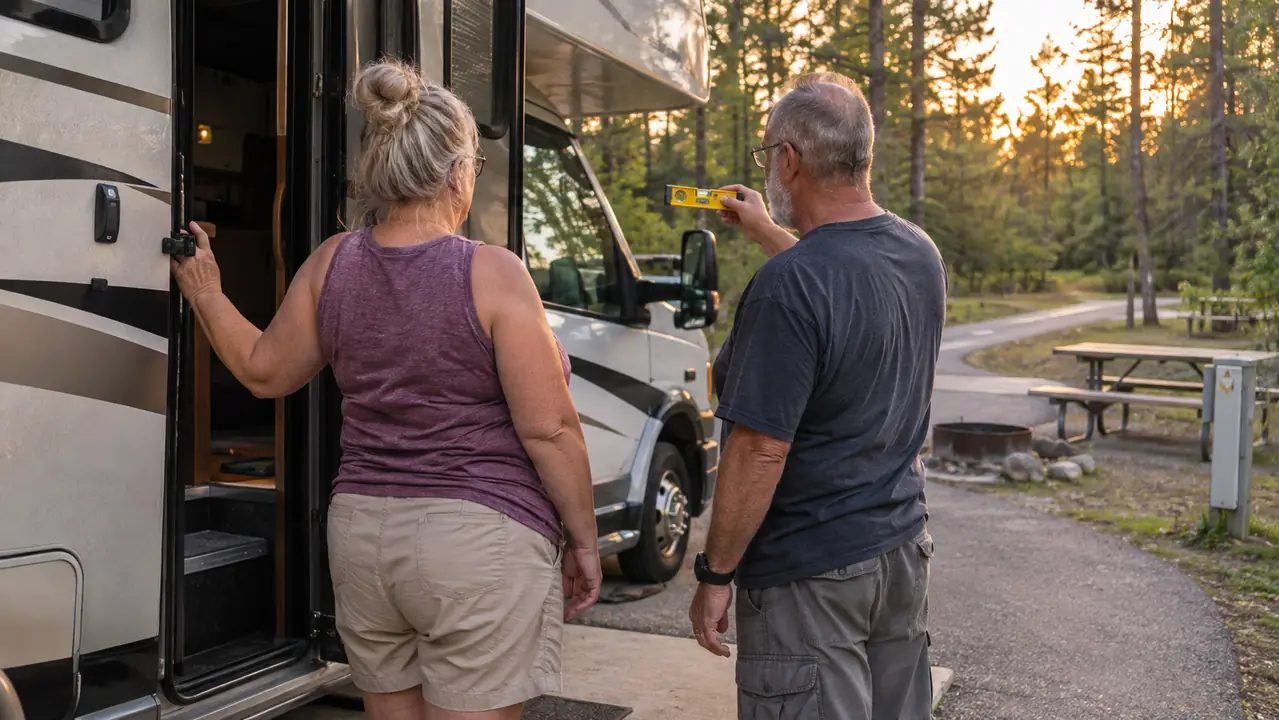
There is a moment at every campsite when you find out whether your rig will sit level, and in our first season that moment was never a good one. Dean would haul a pair of scrap 2x8 boards out of the storage bay, kneel in the gravel, and shove one under a rear tire while I stood at the door with a little bubble level calling out which way we were leaning. If the ground was wet, the boards slid. If the site was off by more than an inch, we needed a second board under the first, and then a third, and by that point we were stacking wet lumber under a 25 foot Class C and both of us were in a mood before the awning was out.
About two and a half years ago we retired the boards and bought the Tri-Lynx Lynx Levelers 11 pack, which is ten interlocking leveler blocks, one Lynx Cap level top, and a nylon storage bag with a handle. I am not going to tell you they transformed our camping. I am going to tell you what they actually do, where they genuinely fall short, and which RVer should keep walking. That is the review I wanted before I bought them, and it is the one the listings do not give you.
The Quick Verdict
A simple, unpowered way to level a rig without jacks, once you understand that each interlocked block adds one inch, not an inch and a half.
Amazon Check Today's Price →Ten blocks, one cap, and no more wet lumber in the storage bay
The 11 pack is the exact kit we own: ten interlocking leveler blocks, one Lynx Cap level top, and a nylon storage bag with a handle. It rides in the outside bay and comes out at every stop.
Amazon Check Today's Price on Amazon →How I've Used Them, and For How Long
We own one 11 pack. We bought the motorhome three years ago and the blocks about two and a half years ago, which puts them at somewhere around fifteen trips so far. Ours is a used 2019 Class C, about 25 feet, and it has no leveling jacks. That detail matters, because it means these blocks are not a nicety for us. They are the only thing standing between us and a refrigerator door that swings open on its own every time we walk past it.
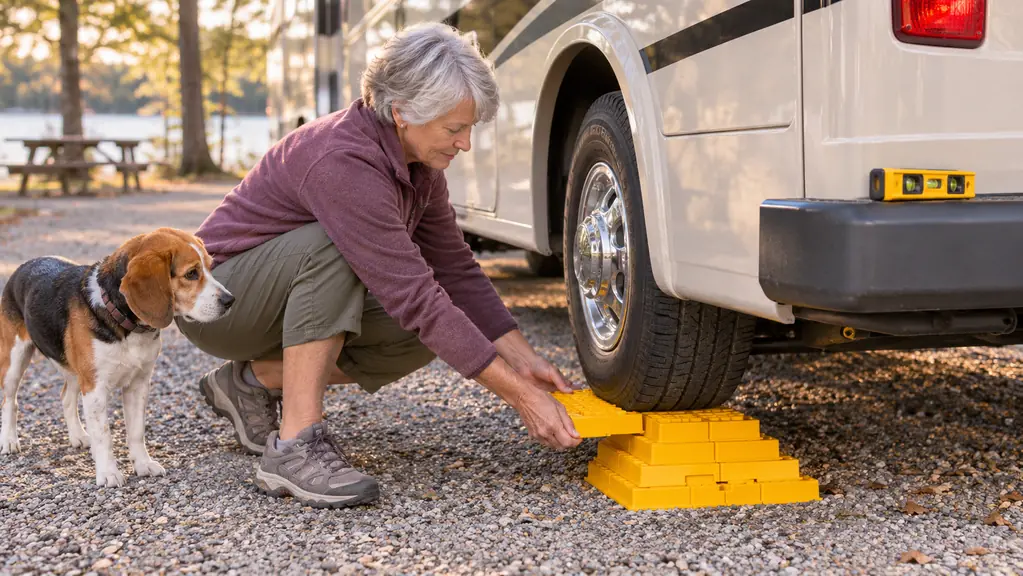
We camp about six times a year, four to ten nights at a stretch, mostly state parks and private RV parks in Texas, Oklahoma, Arkansas and New Mexico on 30 amp hookups. The blocks come out at every single one of those stops. The routine never varies. Dean pulls in, I get out and look at the site, and we decide which side is low before he shuts the engine off. He sets a stack behind or under the low tire, walks the coach up onto it, and I watch the level. If it is close but not quite, the Lynx Cap goes on top of the stack for another quarter inch. Then everything goes back in the bag, the bag goes in the outside bay, and we are finished in under five minutes.
One stop sticks in my mind because it was so ordinary. A state park outside Ardmore, Oklahoma, in October, on a gravel pad that looked flat as a table from the road and turned out to drop about two inches toward the fire ring. Blocks out, one stack under the low rear tire, cap on top, and we were sitting under the awning with coffee inside twenty minutes of pulling in. Nothing dramatic happened. That is the whole point. The leveling part of the afternoon simply stopped being a thing we had to think about.
I want to be clear that five minutes is the good version. It is five minutes when the site is honest and we only need one stack. On a pad that slopes in two directions at once, we are out there for fifteen, moving blocks from one tire to another and starting over. That is not the blocks failing. That is a bad pad. But it is worth knowing before you buy, because the listings all show one tidy little stack under one tire and never show the part where you redo it.
The Height Math Nobody Explains Up Front
Here is the thing I wish the Tri-Lynx listing had put in plain language. A Lynx Leveler block is 8.5 inches square and 1.5 inches tall, but it only adds one inch of height when it is interlocked with the block underneath it. So the first block gives you an inch and a half. Every block you add on top of that gives you one more inch. A three block stack is 3.5 inches of lift, not 4.5, and I have stood at campgrounds watching people expect the bigger number and then wonder why the coach is still leaning.
The Lynx Cap is the fine adjustment, and it is more useful than it sounds. It is 8.5 by 8.5 and half an inch thick, and it only adds a quarter inch to the stack when it is interlocked on top. A quarter inch does not sound like anything. It is not nothing. On a 25 foot rig, a quarter inch at the rear tire is the difference between a bubble level that sits inside the lines and one that sits just outside, and it is the difference between the bathroom door staying where you put it and swinging shut on its own all week.
I measured that once with a tape because I did not believe it. Our level is a small one, maybe nine inches long, and a quarter inch of lift at the rear tire walks the bubble most of the way across its window. Dean laughed at me for standing there with a tape measure in the gravel. Then he started asking me to put the cap on first instead of last, and he has not stopped asking since.
The other piece of math is the one about how many you get. Ten blocks sounds generous until you work it out. A two block stack under one rear tire and a one block stack under the other uses three of them. If you build a step of blocks to walk the tire up onto, that is one or two more. We have never needed all ten at once. We have needed six, twice, both times on gravel pads that looked flatter from the road than they turned out to be.
What They Actually Fixed
The boards never gripped. That was the whole problem. A wet 2x8 on wet gravel will slide out from under a tire while you are watching it happen, and there is a specific sick feeling that comes with seeing your coach drop a couple of inches sideways. The blocks interlock, so a stack behaves like one piece instead of three pieces pretending to be one piece. In two and a half years I have never had a stack come apart under the tire. Not once, not in rain, not on gravel, not on a pad that was more mud than gravel.
The second thing they fixed was the storage bay. Dean cut those boards himself out of a single 2x8 he bought at the lumber yard in Tyler, long enough to be safe under the tire and short enough to fit the bay, which was a compromise that did neither job well. They were heavy, they did not stack neatly, and they lived loose in the bay shifting around going down the road. The whole 11 pack stacks into one bundle that drops into the nylon bag, and the bag has a handle, so it comes out in one hand and goes back in one hand. I carry the bag myself now. I never once carried both boards.
And they do not rot, splinter, or soak up water. That sounds like a small claim until you have pulled a board out of a bay after a rainy week and found it heavier than when you put it in. The Tri-Lynx blocks we own have been rained on, frozen on, and driven over for two and a half years, and they look like the day they came out of the bag. The listing says they have been manufactured in the USA since 1992. I cannot vouch for the history, only for ours.
A wet 2x8 on wet gravel will slide out from under a tire while you are watching it. Two and a half years on these blocks and I have never had a stack come apart.
The Parts That Annoy Me
One cap. The 11 pack comes with exactly one Lynx Cap, so if both rear tires need a fine tune, only one of them gets it. I understand the reasoning on cost, but it means the fine adjustment is a one wheel tool. We work around it by putting the cap under whichever tire is closest to level and letting the other side be slightly off. Slightly off is fine for most of a trip. It is not fine for the coffee cup on the counter.
Driving up onto a stack is a two person job for us, and it is the part I like least. There are no ramps in the kit, so you are not driving straight up onto a two block stack. Dean sets one block down as a step, walks the tire up onto it, and then adds the rest of the stack behind it. It works. It is also the ten seconds where I stand behind the coach with my hand up saying stop three times, and where I would rather be doing anything else.
They do not level anything on their own, and I want to be plain about that. The Tri-Lynx listing calls the lift type manual, and manual is exactly right. You are the sensor, you are the decision maker, and you are the one kneeling in the gravel counting inches in your head. If you want to press a button and have the coach level itself, this is not that product and no amount of careful stacking turns it into that product. I do not mind the kneeling. I mind it in the rain.
The last annoyance is settling. On soft ground a stack will press in overnight, and by morning the bubble that was perfect is not. One lakeside park in March taught me that in about four hours. It rained most of the second night, the pad went from firm gravel to something closer to pudding, and by breakfast the bathroom door had started drifting shut on its own. We pulled the stack, moved it a foot toward the road where the gravel was still firm, and rebuilt it in the rain. Twenty minutes, and it held the rest of the week. That is the worst thing I can say about these blocks after two and a half years, and it is not really the block's fault.
What I Liked
- The interlocking stack stays put; ours has never slid or come apart in two and a half years
- The Lynx Cap adds a quarter inch of fine adjustment, which is enough to matter on a 25 foot rig
- No rot, no splinters, and no water weight, unlike the 2x8 boards they replaced
- The full 11 pack drops into the included nylon bag and stores in one hand
- Ten blocks cover both rear tires and most front situations on a 25 foot Class C
Where It Falls Short
- Only one Lynx Cap in the pack, so only one wheel gets the fine tune
- Each interlocked block adds one inch rather than 1.5, so a stack is shorter than people expect
- No ramp in the kit, so walking a tire up onto a stack takes a spotter and patience
- Completely manual, with no gauge and nothing to tell you when you are level
- Stacks press into soft ground overnight and may need a mid trip adjustment
- Ten blocks run out on gravel pads that are badly out of level
What I'd Tell Someone Standing at the Next Site Over
Get the whole kit. If you are going to own these at all, own enough of them to build two proper stacks, because a tall tower under a single tire is a wobbly and nerve wracking thing to walk a coach up onto. The 11 pack has been the right amount for a 25 foot Class C in every situation we have met, including the gravel pads that made us doubt it.
And check the level again after you are set up, not just before. The first five minutes at a site are the easiest time to fix a mistake and the last time you will want to think about it. If the refrigerator door swings, or the bathroom door will not stay where you put it, that is your answer, and it is usually a quarter inch that the cap can take care of.
Who This Is For
This is for the RVer with no leveling jacks, or with jacks that stabilize but do not lift, who wants a simple unpowered way to get the coach close to level without a system to maintain. It suits a Class C or a travel trailer in the 25 to 30 foot range on the kind of pads most state parks have, meaning gravel, asphalt, or packed dirt that is off by an inch or two. It also suits anyone who has been hauling lumber around and is tired of it, which was us two and a half years ago.
It works for a couple, and it works for one person with some patience, but be honest with yourself about the spotting. If you cannot see the tire from the driver's seat and you do not have someone to wave you on, practice somewhere flat and empty before you try it on a strange pad at dusk with a dog who wants her dinner. Biscuit has slept through most of our leveling arguments. She is not a reliable spotter.
Who Should Skip It
If your motorhome has push button leveling jacks, skip these and use the jacks. That is the honest answer and it costs me nothing to say it. I have never owned electric leveling jacks and I am not going to pretend otherwise, but I have stood at a site and watched a neighbor press a button and be level before Dean had the bag out of the bay. That convenience is real, and blocks do not provide it.
Skip them too if your usual sites are consistently off by more than three or four inches, because you will be building towers and towers are where this gets nervy. Skip them if you cannot kneel or squat comfortably, since there is no version of this where you do not get down near the ground at least twice a trip. And skip them if you want a gauge, a light, or an app to tell you what to do. There is none of that here. The blocks are inert plastic, your eyes are the instrument, and the work is yours.
Ten blocks, one cap, and one fewer thing to argue about at check in
This is the exact kit we have used for two and a half years: ten interlocking leveler blocks, one Lynx Cap level top, and the nylon storage bag. It outlasted the boards it replaced.
Amazon Check Today's Price on Amazon →