
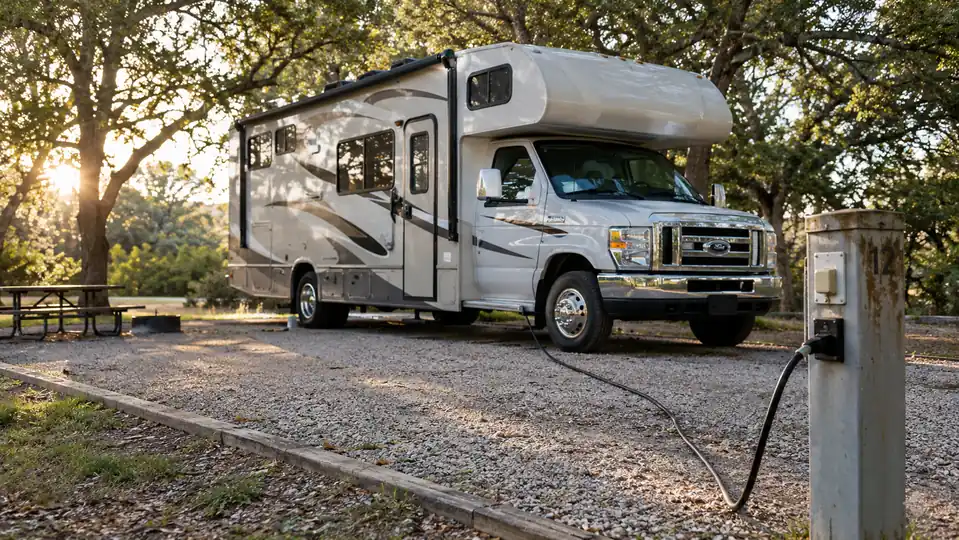
Three years ago I stood at a campsite outside Tyler with a brand new surge protector in one hand and the motorhome's power cord in the other, honestly unsure which end went into the pedestal first. Dean was inside wrestling with the leveling blocks. The camp host, a full-timer named Roy, took pity on me and walked me through it in about ninety seconds. That was my introduction to the Progressive Industries SSP-30XL, which we bought before our first trip and have plugged in at every hookup since.
This is the honest version of that review. Not the version where everything is wonderful and a small plastic box changed our lives. We have used this unit for three years, across roughly eighteen trips, at state parks and private RV parks in Texas, Oklahoma, Arkansas and New Mexico, almost all of them 30-amp sites. It has done its job every time I asked it to. It has also annoyed me in a couple of small ways, and there are people for whom it is the wrong purchase entirely. Both of those belong in a review, and most of what I read before we bought it left them out.
The Quick Verdict
A simple, sturdy 30-amp surge protector that tells you what the pedestal is doing before you commit. It is not a voltage regulator, it will not fix a campground, and it is not an electrical management system. Buy it for surge protection and honest indicator lights, not for rescue.
Amazon Check Today's Price →Thirty amps, 825 joules, and a light that tells you the truth
The portable unit we have plugged in at every hookup for three years. No wiring, no installation, no cutting into the motorhome. It sits between the pedestal and your cord and reports what it sees.
Amazon Check Today's Price on Amazon →What the SSP-30XL Actually Does
Start with the plain facts, because nearly all the confusion around this thing comes from people expecting it to be something else. The Progressive Industries SSP-30XL is a portable 30-amp surge protector rated for 120 volts and 3,600 watts, with an 825-joule surge rating. It measures about 14 inches long and 5.25 inches wide and weighs 2 pounds. The housing is a durable plastic, listed as Lexan, and it ships with a locking bracket, a cover and an all-weather shield assembly. The only interface on the whole unit is a set of LED indicators.
What that means at a campsite is simple enough. The unit plugs into the pedestal, your RV cord plugs into the unit, and the indicators report what the unit sees at that receptacle. Ours has told us, over three years and eighteen trips, mostly that things were fine. Once it told us they were not, and I will get to that.
What it does not do matters just as much. It does not manage voltage. It does not step low voltage up or high voltage down, and it does not take over the job of an electrical management system that watches the feed and interrupts it when the power drifts out of range. If that is what you are shopping for, this is the wrong box, and I would rather say so on the first screen than have you work it out at a campground in July with the air conditioner already running.

How We've Used It for Three Years
Our motorhome is a used 2019 Class C, about 25 feet, and we tow nothing. We take roughly six trips a year, most of them four to ten nights, and we are on 30-amp hookups almost every time. The routine has not changed since the first trip. Breaker off at the pedestal. Protector into the pedestal. Our cord into the protector. Breaker on. Then I read the indicators before I turn anything on inside.
That last part is the habit the unit gave me. Before we owned it, I would have plugged in and gone about my business, the way I did when we tent-camped and never thought about the power at all. Now I stand there for a few seconds and read the lights the way you glance at a gas gauge. It is a small thing, and over three years it has become the whole point for me. The protector is not doing anything clever. It is giving me one piece of information at the moment I need it, which is before I have committed to a site, unpacked the dog, and put the coffee on.
In our second year, at a private RV park in Arkansas, the indicator showed a wiring fault at the pedestal. I did not know exactly what the fault was and I still do not, because I am not an electrician and the unit does not diagnose in sentences. What I knew was that the lights were not the normal pattern. We walked to the office, explained it, and asked for a different site. The new pedestal read fine. Nothing in the motorhome was damaged, then or ever. That is the entire electrical story of our three years, and I am not going to inflate it into something more dramatic than it was.
Three years in, the unit itself looks like a piece of equipment that lives in a storage bay. The housing is the Lexan shell Progressive Industries lists on the box, and it has taken scuffs from riding next to the leveling blocks and the water hose. The cover is still with it. The locking bracket is still with it. Nothing has cracked, nothing has come loose, and nothing about it has made me think it is on its way out. Dean wipes it down once a season and puts it back in the bay. That is the whole maintenance record.
Before we owned it, I would have plugged in and gone about my business. Now I stand there and read the lights the way you glance at a gas gauge.
What Nobody Tells You Before You Buy
Here is the part I wish someone had said to me in the lot at the dealer, in plain language, instead of leaving me to figure it out over three seasons of trial and error.
It makes your cord run longer
The protector is about 14 inches long, and that length does not disappear when you plug it in. On pedestals where the outlet sits inside a closed box, adding a foot of hardware between the receptacle and your cord can mean the lid will not shut, or your cord has to loop awkwardly to reach. Most of the time it is fine. Twice it has been a small nuisance, and once I had to reposition the whole run so the weight of the cord was not hanging off the connection. If you are already tight on cord length at a site, this makes you tighter.
Portable cuts both ways
Portable is the reason we bought it. No wiring, no installation, no cutting into the motorhome's electrical system, and if it ever gives up we unplug it and we are back to a plain cord with no appointment and no bill. The other side of portable is that it is a 2-pound object sitting outdoors at a campground, which is exactly why it comes with a locking bracket. We use the bracket every time. I am not going to tell you a story about someone walking off with one, because I do not have one and I will not invent it. I simply do not leave it sitting loose when we head to the bathhouse.
It is not an electrical management system
This is the confusion that catches people, and it caught me. A surge protector absorbs a spike. An electrical management system watches voltage over time and steps in when the feed drifts out of range. Those are different jobs and the difference in cost between them is real. Progressive Industries builds both kinds, and the hardwired route is a different purchase and a different afternoon of work under the rig. We chose the simple version on purpose and I would choose it again for the way we camp, but I want you to know which one is in the box before you carry it to the register.
Rain is the part nobody explains well
The unit ships with an all-weather shield assembly and the housing is built to sit outdoors. That does not make it something you ignore in weather. When we know a storm is coming, I check that the shield is seated properly and that the connection is not sitting in a puddle at the base of the pedestal. I have left it out in rain many times without a problem. I still do not treat any object sitting on the ground at a campsite as waterproof forever, and neither should you.
What I Check at the Pedestal Now
Three years of doing this has turned into a short routine that has nothing to do with the brand and everything to do with paying attention. Breaker off first, always. Protector seated fully, not halfway, because a loose fit is a worse connection than no fit. Cord plugged in with the weight supported so nothing hangs off the joint. Breaker on. Then I read the indicators before I turn anything on inside, and I look again a minute later, because a reading that changes after the load comes on is worth knowing about.
If the lights do not look right, I do not troubleshoot it myself. I do not open anything, I do not wiggle connections, and I do not decide that it is probably fine this once. I walk to the office. That is the honest value of a device like this. It does not make a campground safe and it will not save you from a badly maintained pedestal. It makes you look, at the one moment when looking is cheap and easy, and the rest of the job belongs to you and the camp host.

The Question Everyone Asks: Why Not the Hardwired Version?
I get this from neighbors at campgrounds more than any other question, usually while somebody is holding a flashlight under my rig. The honest answer is that a hardwired unit does more and I know it. It lives inside the motorhome, it is never left behind, nobody can walk off with it, and the better ones watch the feed in ways this box simply does not. Progressive Industries makes that version too, and I have looked at the listing for it more than once. If I were starting over and I were comfortable with tools and wiring, I would look hard at that route before I bought this one.
We are not that household. Dean is handy and I am not, we bought a used motorhome three years ago as our first and only RV, and the idea of cutting into the electrical system to install anything made both of us uneasy. This unit asked nothing of us. It plugged in and it worked and it still works. That is worth something, and it is also a limitation, and a review that only gives you the first half of that sentence is not much of a review. If you want the deeper comparison, that is a separate read entirely, and I would do it before you decide.
What I Liked
- Plugs in between the pedestal and your cord with no installation, no wiring and no cutting into the RV
- 30-amp, 120-volt rating and an 825-joule surge rating that match a typical 30-amp Class C hookup
- The LED indicators gave us a clear reading on a faulty pedestal in Arkansas before we plugged the motorhome in
- All-weather shield assembly and locking bracket both included in the box rather than sold as extras
- 2 pounds and about 14 inches long, so it stores in the outside bay alongside the rest of the electrical gear
- Three seasons of use with no cracking, no loose parts and no failures
Where It Falls Short
- It is a surge protector only. It does not manage voltage and it is not an electrical management system
- The extra 14 inches between pedestal and cord can keep a closed pedestal lid from shutting
- Portable means it sits outdoors and could walk away, so the locking bracket is not optional in my book
- The lights tell you that something is wrong, not what is wrong or what to do about it
- It is one more item to connect and coil on a wet pack-up morning
The Parts I Don't Love
The indicators are the whole interface, and that is both the appeal and the frustration. They are enough to tell you the pedestal is not right. They are not enough to tell you why, and they are not a substitute for the camp host's knowledge or for walking to the office and asking a question. Twice I have wanted a sentence instead of a light, and twice I have gone and found a person instead. That is a fair trade for this much simplicity, but it is a trade and I would be glossing over it if I called the thing perfect.
The other complaint is smaller and entirely about me. It is one more object in the setup and pack-up routine. On a rainy morning when we are trying to be out of a site before checkout, unplugging the cord, unplugging the protector, coiling both and stowing them takes an extra minute. A hardwired unit would be invisible and I would never think about it. We chose visible and simple, and I would choose it again, but I notice that minute every single time it rains.
Who This Is For
This is for the camper with a 30-amp rig who wants surge protection without cutting into the motorhome's wiring, and who will actually stand at the pedestal and look at the indicators. That is the whole thing, honestly. If you are willing to spend ten seconds reading lights before you plug in, this is a well-built little box that has earned its place in our storage bay. Our setup is modest, our trips run four to ten nights, and Biscuit rides along on every one of them. We are on 30-amp service the vast majority of the time, and this matches the way we camp rather than the way somebody with a bigger rig and a bigger budget camps.
It also suits anyone who, like me, came to RVing late and does not want to learn electrical work in order to feel safe at a hookup. There is a real place for a product that asks nothing of you and gives you one clear piece of information at the right moment. Roy explained it to me in ninety seconds at a campsite outside Tyler, and I have not needed another explanation since.
Who Should Skip It
Skip it if what worries you is voltage drift rather than a spike, because this will not help you with that. Skip it if you want something installed and forgotten, because this is neither installed nor forgettable. Skip it if you are on 50-amp service, since this is a 30-amp, 120-volt unit and that is a different purchase. Skip it if you expect a device to diagnose a campground's wiring for you, because it will point at a problem and then stop talking. And skip it if you already own an electrical management system, because you have the better tool for the job and this would be a step sideways. None of that makes it a bad product. It makes it the wrong product for some people, and I would rather you hear that from someone who has used one for three years than discover it yourself at a pedestal in the rain.
The box that told us to move sites before we plugged in
Portable 30-amp surge protection with an 825-joule rating, LED indicators, an all-weather shield assembly and a locking bracket included. The same unit we have carried on every trip for three years.
Amazon Check Today's Price on Amazon →